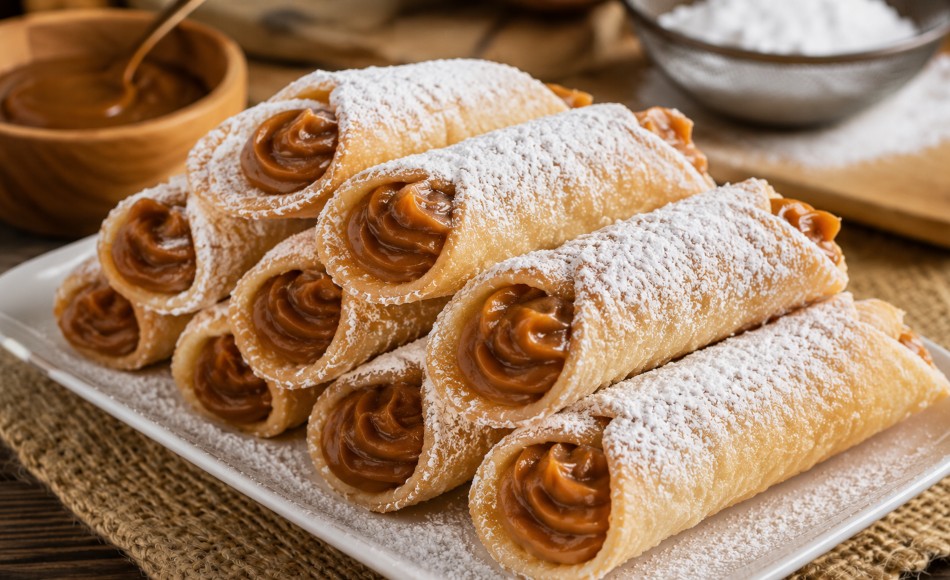
Guargüeros are small Peruvian pastries made from a thin egg-yolk dough that is fried until crisp and delicate. The dough is folded or joined at opposite corners to create a hollow tube, which is filled after cooling and finished with powdered sugar. Their name is associated with a colloquial word for the throat, reflecting their distinctive tubular shape.
Although guargüeros are historically associated primarily with Moquegua and the colonial confectionery tradition of southern Peru, they are also prepared in other parts of the country. In the Piura adaptation, the most representative filling is the region’s natilla, traditionally made from goat’s milk and chancaca, rather than the lighter dulce de leche used elsewhere. This variation connects a colonial-style pastry shell with one of Piura’s signature sweets.
The finished pastry offers a distinct contrast: a fragile, crisp shell surrounding a dark, concentrated filling with a deep caramel flavor. Guargüeros are served at family gatherings, celebrations, and dessert tables in small portions.
Print
Peruvian Guargüeros
- Prep Time: 1 hour
- Cook Time: 1 hour 10 minutes
- Total Time: 2 hours 10 minutes
- Yield: 24
- Category: Dessert
- Cuisine: Peruvian
Ingredients
For the Piura-style natilla
- 1 liter fresh goat’s milk (4 cups)
- 300 g chancaca or dark panela, chopped
- 100 ml water (⅓ cup plus 1 tablespoon)
- 30 g rice flour (¼ cup)
- 100 ml cold goat’s milk (⅓ cup plus 1 tablespoon), taken from the total amount
- 1 cinnamon stick
- 2 whole cloves
- 1 g baking soda (¼ teaspoon)
For the Dough
- 250 g all-purpose flour (2 cups)
- 3 g baking powder (¾ teaspoon)
- 1 g salt (¼ teaspoon)
- 5 egg yolks
- 30 g unsalted butter, melted (2 tablespoons)
- 30 ml pisco (2 tablespoons)
- 15 to 30 ml water (1 to 2 tablespoons)
- 30 g egg white (1 egg white), for sealing
For frying and finishing
- Vegetable oil for frying
- Powdered sugar for dusting
Preparation
- Make the chancaca syrup, place the chopped chancaca and water in a small saucepan. Cook over medium heat for 8 to 10 minutes, stirring occasionally, until completely dissolved. Strain the syrup to remove any impurities and set it aside.
- Cook the natilla base, reserve 100 ml of the cold milk and whisk it with the rice flour and baking soda until smooth. Heat the remaining goat’s milk with the cinnamon and cloves in a wide, heavy-bottomed pot. When it begins to simmer, add the chancaca syrup and cook over low heat for 15 minutes, stirring frequently.
- Thicken the filling, remove the cinnamon and cloves. Slowly pour in the dissolved rice flour while stirring constantly and continue cooking over low heat for 35 to 45 minutes. Scrape the bottom and sides continuously until the natilla becomes very thick, holds its shape, and begins to pull away from the pot. Transfer it to a dish, cover the surface directly, and let it cool completely.
- Make the dough, sift the flour, baking powder, and salt together. Make a well in the center and add the egg yolks, melted butter, and pisco. Mix from the center outward until a firm dough forms. Add the water gradually only when needed. Knead for 5 minutes until smooth, wrap it, and let it rest for 30 minutes.
- Roll and cut the dough, divide it into two portions and roll each one on a lightly floured surface to approximately 1/16 inch thick. Cut it into 2¾-inch squares and lightly prick the centers with a fork, avoiding the edges so they remain easy to seal.
- Shape the guargüeros, position each square like a diamond and bring two opposite corners together to create a tube. Brush one corner with egg white, overlap the other, and press firmly. Keep the center open so the pastry can be filled after frying.
- Fry the shells, heat the vegetable oil to 350 °F. Fry the guargüeros in small batches for 1 to 2 minutes, carefully turning them until puffed and lightly golden. Do not allow them to become dark brown. Transfer them to paper towels and let them cool completely.
- Fill and finish, place the cold natilla in a piping bag fitted with a small tip. Pipe the filling into both ends of each guargüero so it reaches the center. Arrange the pastries on a serving platter and dust them with powdered sugar immediately before serving.
Chef’s Tips
- Cook the natilla until it is firmer than natilla intended to be eaten with a spoon. A loose filling will leak from the pastry shells.
- Use goat’s milk for the traditional Piura flavor. Whole cow’s milk can be used, but the result will be milder.
- Roll the dough very thin so the shells become delicate and crisp rather than hard.
- Do not add all the water at once. The amount required depends on the size of the yolks and how much liquid the flour absorbs.
- Seal the corners firmly with egg white so they do not open during frying.
- Make sure both the shells and filling are completely cool before assembling the pastries.
Traditional Variations
Outside Piura, the most common Peruvian version is filled with manjar blanco and dusted with powdered sugar. Egg-yolk dough, frying, dulce de leche filling, and powdered sugar are recurring characteristics of traditional guargüero recipes.
In the Piura version, the regional natilla replaces manjar blanco. This traditional sweet is made with goat’s milk and chancaca and has a darker, more concentrated, slightly grainy consistency.
Some families form straight tubes around small metal molds, while others simply overlap two corners of a square. Recipes may omit the pisco or use lard instead of butter, but flour and egg yolks remain the defining base of the pastry.
Traditional Serving Style
Arrange Piura-style guargüeros on a wide platter in a single layer or place each one in a small paper cup. Dust them with powdered sugar shortly before serving so the sugar remains visible instead of absorbing moisture from the pastry.
They are commonly offered as small after-meal sweets at birthdays, baptisms, weddings, family gatherings, and dessert tables. Because the natilla filling is rich and concentrated, one or two pastries per person are generally sufficient.
Recommended Pairings
- Unsweetened Peruvian-style brewed coffee
- Black tea
- Cinnamon tea
- Sweet or lightly fermented chicha de jora
- Guargüeros can also be served on their own as small dessert pastries.
Origin and Tradition
Guargüeros belong to the group of sweets developed during Peru’s colonial period, when European confectionery methods were adapted to local ingredients and customs. Their regional origin is associated mainly with Moquegua, where they remain a traditional pastry connected particularly with religious celebrations.
As the pastry spread through different parts of Peru, its filling could be adapted to regional specialties. In Piura, natilla is a particularly meaningful choice because this goat’s milk and chancaca confection is one of the region’s best-known traditional sweets. The Piura-style guargüero therefore combines a classic Peruvian pastry shell with a filling deeply connected to northern coastal food culture.
Frequently Asked Questions
The main difference is the filling. The most widely known Peruvian guargüero is filled with manjar blanco, while the Piura variation uses the region’s goat’s milk and chancaca natilla. This filling is darker, firmer, and more intensely caramelized than regular dulce de leche.
Goat’s milk is the traditional Piura choice and gives the filling a more pronounced flavor. Whole cow’s milk may be used when goat’s milk is unavailable, although the result will be milder. In either case, cook the natilla until it is firm enough to remain inside the shells.
They usually open because the corners were not sealed firmly, had too much flour on them, or the oil was too hot. Brush away excess flour, use egg white as an adhesive, and press the corners together firmly. Fry at approximately 350 °F so the shells hold their shape.
Roll the dough very thin and fry it in properly heated oil. Thick dough produces hard guargüeros, while cool oil makes them absorb excessive fat. Pisco also helps create a lighter shell because part of its alcohol evaporates quickly during frying.
The natilla can be prepared up to 3 days ahead and refrigerated. The fried shells keep for about 2 days in an airtight container at room temperature. To preserve their crispness, fill the guargüeros on the same day you plan to serve them.