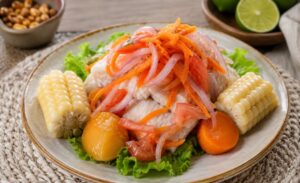

In the Peruvian Amazon, patarashca is one of those dishes that reflects the close connection between the river, fire, and the leaves of the forest. It is traditionally made with fresh fish seasoned with chili pepper, onion, garlic, sachaculantro or cilantro, then wrapped in bijao leaves and cooked over charcoal, on a grill, or over gentle embers.
This dish is strongly associated with Peru’s Amazon regions, especially Loreto, San Martín, Ucayali, and Madre de Dios. It is commonly enjoyed at family lunches, local markets, regional celebrations, and outdoor meals, where the aroma of the toasted leaf is an essential part of the experience.
Patarashca is not meant to be complicated. Its appeal comes from respecting the natural flavor of the fish and cooking it inside the leaf, which keeps it moist and gives it a distinctive herbal fragrance. This version follows the most representative traditional style of the Peruvian Amazon.
Print
Peruvian Patarashca
- Prep Time: 20 minutes
- Cook Time: 25 minutes
- Total Time: 45 minutes
- Yield: 4
- Category: Main Course
- Cuisine: Peruvian
Ingredients
- 800 g fresh fish, whole or in thick fillets (4 portions)
- 120 g red onion, finely chopped (1 medium onion)
- 40 g Amazonian sweet chili, chopped, or seeded ají limo, chopped (3 tablespoons)
- 10 g minced garlic (2 cloves)
- 20 g sachaculantro, chopped, or fresh cilantro, chopped (½ cup)
- 30 ml lime juice or sour grapefruit juice (2 tablespoons)
- 30 ml vegetable oil (2 tablespoons)
- 8 g salt (1½ teaspoons)
- 2 g ground black pepper (½ teaspoon)
- 4 large bijao leaves, cleaned and softened over heat
- Kitchen twine, bijao strips, or natural fiber for tying
Preparation
- Prepare the leaves, wash the bijao leaves and pass them briefly over an open flame or a hot skillet until they become flexible and glossy. This keeps them from tearing when you wrap the fish and helps release their aroma during cooking.
- Season the fish, clean the fish well, pat it dry with paper towels, and rub it with salt, pepper, minced garlic, lime juice, and oil. Let it rest for 10 minutes so it absorbs the seasoning while staying fresh and delicate.
- Mix the Amazonian seasoning, combine the red onion, chopped chili, and sachaculantro in a bowl. Adjust the salt if needed and mix until you have a fresh, aromatic, slightly spicy filling.
- Wrap the patarashca, place one portion of fish on each bijao leaf, cover it with the onion, chili, and herb mixture, and fold the leaf into a sealed packet. Tie each bundle firmly so the juices stay inside during cooking.
- Cook over heat, place the packets on a hot grill, over gentle embers, or in a heavy covered skillet. Cook for 10 to 12 minutes per side, depending on the thickness of the fish, until the leaf is toasted outside and the fish is juicy, white, and flakes easily with a fork.
- Serve right away, open each packet carefully to preserve the aromatic steam and serve the patarashca hot, directly on the bijao leaf or on a plate with boiled cassava, roasted plantain, or rice.
Practical Cooking Tips
Choose fresh, firm-fleshed fish such as doncella, paiche, gamitana, Amazonian dorado, or sea bass if you are outside the Amazon.
Do not cook patarashca over flames that are too strong, because the leaf may burn before the fish is fully cooked.
Sachaculantro gives the most traditional flavor, but fresh cilantro is a practical substitute if you cannot find it.
Tie the packets securely so the steam cooks the fish evenly and keeps it moist.
Traditional Variations
In some areas of the Peruvian Amazon, patarashca is made with whole river fish, especially when the fish are small or medium-sized.
There are also versions made with ají charapita, a tiny Amazonian chili appreciated for its intense aroma and distinctive heat.
Some home-style preparations add chopped tomato to the filling, although the most representative version keeps fish, onion, chili, and Amazonian herbs as the base.
Traditional Serving Style
Serve patarashca hot, straight from the grill or embers, opening the bijao leaf at the table so the fragrant steam is released.
Traditionally, it is served with boiled cassava, roasted plantain, plain tacacho, or white rice. In the Peruvian Amazon, it may also be accompanied by cocona chili sauce and regional drinks such as aguajina, masato, or camu camu juice.
Recommended Pairings
- Boiled cassava
- Roasted plantain
- White rice
- Cocona chili sauce
- Plain tacacho as a side dish
- Camu camu juice
- Aguajina
Culinary Curiosity
The bijao leaf is more than a natural wrapper: it protects the fish from direct heat and gives it a distinctive herbal aroma. In Peruvian Amazonian cooking, leaves often work like natural cookware or steamers, allowing food to be prepared with few utensils and plenty of flavor.
Frequently Asked Questions
Traditionally, patarashca is made with fresh river fish such as doncella, paiche, gamitana, or Amazonian dorado. The most important thing is to choose firm, fresh fish with a clean flavor, because the leaf-wrapped cooking method concentrates its juices. Outside the Amazon, sea bass, tilapia, or trout can work well.
Bijao leaves are essential to the traditional flavor, but if you cannot find them, banana leaves are the closest practical substitute. The technique will be similar, although the aroma will not be exactly the same. Avoid using foil if your goal is a more authentic preparation.
The most traditional method is to cook it over embers or on a grill, because the heat toasts the leaf and adds a subtle smoky aroma. You can also cook it in a covered skillet or in the oven if you do not have a grill, as long as the fish stays tightly wrapped so it steams in its own juices.
It can be mild or spicy depending on the chili used. In the Peruvian Amazon, cooks often use sweet chili, ají charapita, or regional chili peppers. For a milder flavor, remove the seeds and veins or use a smaller amount.