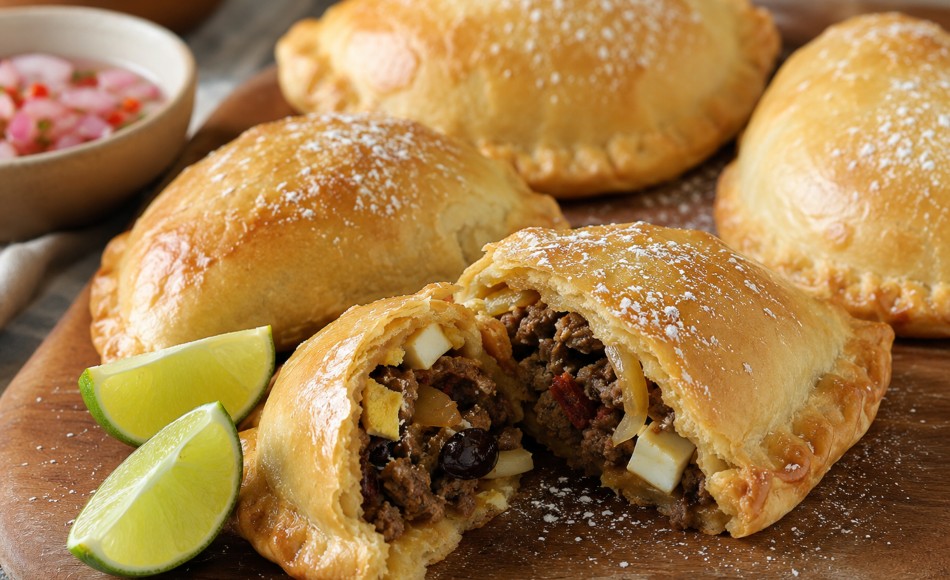
Peruvian picadillo empanadas are traditional savory pastries made with a lightly sweet, tender crust and a filling of seasoned beef, onions, ají panca, black olives, hard-boiled eggs, and raisins. The contrast between the savory filling and small sweet accents is one of their most recognizable characteristics.
They are commonly sold in bakeries and cafés and served at family gatherings and celebrations. They may be enjoyed as an appetizer, snack, or light meal, usually dusted with powdered sugar and accompanied by lime wedges.
The most representative Peruvian version is baked rather than fried. The pastry should be golden and tender, while the filling must be fully cooked and completely cooled before assembly so it does not soften the dough.
Print
Peruvian Picadillo Empanadas
- Prep Time: 50 minutes
- Cook Time: 50 minutes
- Total Time: 1 hour 40 minutes
- Yield: 12
- Category: Appetizer
- Cuisine: Peruvian
Ingredients
For the dough
- 500 g all-purpose flour (4 cups)
- 10 g baking powder (2 tsp)
- 8 g salt (1 1/2 tsp)
- 40 g white sugar (3 tbsp)
- 200 g cold butter, cut into cubes (3/4 cup plus 2 tbsp)
- 2 egg yolks
- 180 ml cold water (approximately 3/4 cup)
- 1 egg, beaten with 15 ml milk (1 tbsp), for brushing
For the filling
- 500 g ground beef
- 30 ml vegetable oil (2 tbsp)
- 300 g red onion, finely diced (2 medium onions)
- 15 g minced garlic (1 tbsp)
- 50 g aji panca paste (3 tbsp)
- 5 g ground cumin (2 tsp)
- 3 g ground black pepper (1 tsp)
- 8 g salt (1 1/2 tsp)
- 60 ml beef broth or water (1/4 cup)
- 80 g raisins (1/2 cup)
- 100 g pitted Peruvian black olives, quartered
- 3 hard-boiled eggs, chopped
- 15 g chopped fresh parsley (1/4 cup)
Preparation
- To make the dough, mix the flour with the baking powder, salt, and sugar. Add the cold butter and rub it in with your fingertips until the mixture resembles coarse crumbs. Incorporate the egg yolks and gradually add the cold water, mixing only until a smooth, uniform dough forms.
- Let the dough rest, shape it into a disc, wrap it, and refrigerate for 30 minutes. Avoid over-kneading, as excessive gluten development can result in hard empanadas instead of tender and crumbly ones.
- Sauté the seasoning, heat the oil in a large skillet over medium heat. Add the onion and cook for 8 to 10 minutes, until translucent and lightly browned. Stir in the garlic, aji panca paste, cumin, pepper, and salt, and cook for 3 minutes, stirring until the seasoning loses its raw taste.
- Cook the picadillo, add the ground beef and break it up with a spoon as it cooks. Once it has completely changed color, stir in the broth and continue cooking for 8 to 10 minutes, until the meat is cooked through and the filling is moist but not runny.
- Finish the filling, add the raisins and cook for 2 minutes. Remove the skillet from the heat, stir in the olives, hard-boiled eggs, and parsley, and mix gently. Spread the picadillo on a platter and let it cool completely before filling the empanadas.
- Roll out and cut the dough, preheat the oven to 190°C (375°F). Divide the dough into two portions and roll each out on a lightly floured surface to about 3 mm (1/8 inch) thick. Cut out discs approximately 14 cm (5.5 inches) in diameter.
- Fill and seal, place 45-50 g (1 1/2-1/2 cups) of cold picadillo (a mixture of ground meat, olives, raisins, and egg) in the center of each disc. Lightly moisten the edge with water, fold the dough over to form a half-moon shape, and press to remove any excess air. Seal with a crimp or the tines of a fork.
- Bake the empanadas, arrange them on a baking sheet lined with parchment paper and brush them with the egg wash (beaten egg with milk). Make a small hole in the top of each empanada to allow steam to escape and bake for 22-28 minutes, or until golden brown.
- Finish and serve, let the empanadas rest for 10 minutes. Sprinkle them lightly with powdered sugar and serve them warm with lemon wedges.
Chef’s Tips
- Cook the onions patiently so they lose their sharpness and add natural sweetness to the filling.
- Cool the picadillo completely before assembling the empanadas.
- Avoid adding too much liquid, which can soften the dough or cause the pastries to open.
- Keep the butter and water cold for a tender crust.
- Do not overfill the dough circles; leave enough space to seal the edges securely.
- Cut a small vent in each pastry so steam can escape during baking.
Traditional Variations
Some Peruvian recipes use beef finely chopped with a knife rather than ground beef. This gives the filling a coarser, more rustic texture.
The amount of raisins and olives varies according to family preference. Some versions also add a small amount of ají amarillo to the seasoning base, although ají panca remains the defining chile.
Certain bakeries combine butter with vegetable shortening or lard in the dough. This produces a more crumbly pastry with a richer flavor.
Traditional Serving Style
Serve the empanadas warm with a very light dusting of powdered sugar. Place lime wedges alongside them so each person can squeeze a little juice over the filling.
They may be presented as an appetizer, afternoon snack, or party pastry. One large empanada is generally sufficient for a snack, while smaller versions work well on celebration tables.
Recommended Pairings
- Lime wedges
- Peruvian creole onion relish
- Homemade chile sauce
- Peruvian-style brewed coffee
- Chicha morada
- Emoliente
- Fresh salad when served as a light meal
Did You Know?
Empanadas arrived in Peru through Spanish culinary traditions but developed a distinct local identity by incorporating Peruvian ingredients and flavor combinations. Ají panca, black olives, raisins, and hard-boiled eggs form one of the country’s most recognizable creole fillings.
The powdered sugar garnish may seem unusual to those unfamiliar with Peruvian cuisine, but it reflects the traditional preference for combining sweet and savory flavors in the same dish.
Frequently Asked Questions
Ground beef with a moderate amount of fat is the most practical option. You may also finely chop the beef with a knife for a more traditional texture. Avoid extremely lean meat because the filling can become dry during baking.
They may open when overfilled, when flour remains on the edges, or when the picadillo contains excess liquid. Brush away loose flour, lightly moisten the edges, and press them securely. A small vent also helps release steam.
Raisins are part of the most recognizable Peruvian creole version and provide its characteristic sweet contrast. However, some households omit them. When using raisins, distribute them evenly so they are not concentrated in only one empanada.
Yes. Assemble and refrigerate the unbaked empanadas for up to 24 hours, keeping them well covered. Brush them with egg immediately before baking. They may also be frozen unbaked and placed directly in the oven with a slightly longer cooking time.
Place them in a preheated 340 °F oven for 8 to 10 minutes. Avoid the microwave because it makes the pastry soft and damp. Frozen empanadas require additional reheating time, and the center should be thoroughly hot before serving.