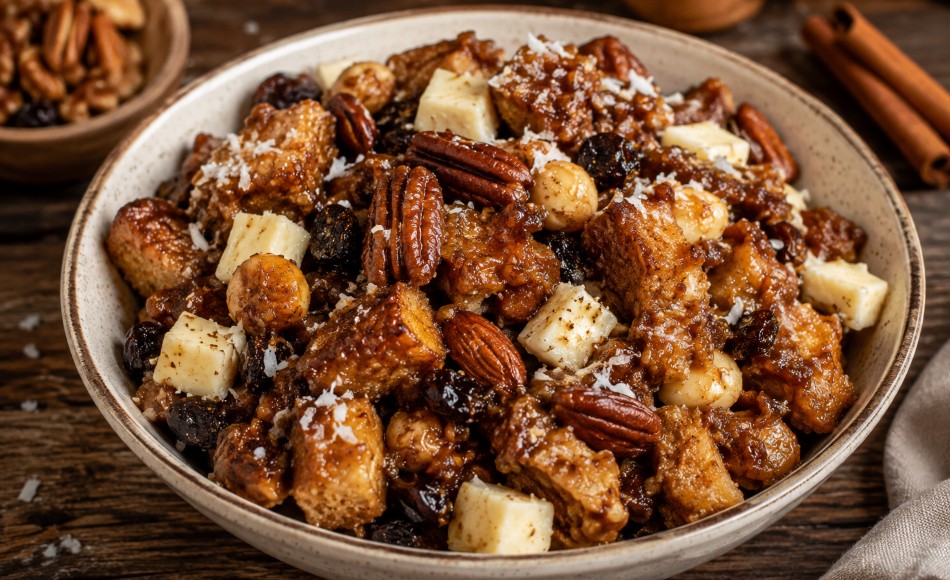
Ranfañote is one of Lima’s oldest and most distinctive traditional sweets. It combines toasted or fried bread with spiced chancaca syrup, dried fruit, coconut, nuts, and chunks of fresh cheese. Its defining quality is the contrast between the rich sweetness of the syrup, the lightly crisp bread, and the mild saltiness of the cheese.
The dessert is associated with colonial-era Lima and with the practice of transforming leftover or stale bread into a flavorful preparation. Some accounts connect its development with Afro-Peruvian cooking, while others attribute it to mestizo bakers of the colonial period. Although it is less widely sold today, it remains part of Peru’s historic confectionery tradition.
Print
Peruvian Ranfañote
- Prep Time: 20 minutes
- Cook Time: 30 minutes
- Total Time: 50 minutes
- Yield: 8
- Category: Dessert
- Cuisine: Peruvian
Ingredients
- 300 g day-old French-style rolls (about 5 medium rolls)
- 30 g butter (2 tablespoons)
- 400 g chancaca or dark panela
- 300 ml water (1 ¼ cups)
- 1 cinnamon stick
- 3 whole cloves
- 2 g anise seeds (½ teaspoon)
- Peel of 1 orange, with the white pith removed
- 60 ml orange juice (¼ cup)
- 50 g shredded coconut (½ cup)
- 50 g dark raisins (⅓ cup)
- 40 g chopped walnuts (⅓ cup)
- 40 g chopped pecans (⅓ cup)
- 150 g unsalted queso fresco, cut into cubes (1 cup)
- 30 ml port wine (2 tablespoons)
Preparation
- Prepare the bread, cut it into approximately ¾-inch cubes. Melt the butter in a large skillet over medium heat, add the bread, and toast it for 6 to 8 minutes, stirring frequently, until golden on the outside while still slightly firm in the center. Remove it from the skillet and set it aside.
- Make the chancaca syrup, place the chancaca, water, cinnamon stick, cloves, anise seeds, and orange peel in a saucepan. Cook over medium heat for 8 to 10 minutes, stirring occasionally, until the chancaca dissolves completely and the syrup becomes fragrant.
- Strain and reduce the syrup, pour it through a fine-mesh strainer and return it to the saucepan. Add the orange juice and simmer over medium-low heat for 5 to 7 minutes, until slightly thickened. Do not reduce it too much, since the bread needs enough liquid to absorb the syrup.
- Add the fruit and nuts, stir in the shredded coconut, raisins, walnuts, and pecans. Cook for 3 minutes, stirring gently, until the raisins begin to plump and the flavors combine.
- Finish the ranfañote, add the port wine and cubes of queso fresco. Cook over low heat for 1 minute, allowing the cheese to warm without melting completely. Add the toasted bread and fold gently until every piece is evenly coated with syrup.
- Rest and serve, remove the pan from the heat and let the ranfañote rest for 5 minutes. Serve it warm, while the bread has absorbed some of the syrup but still retains a little texture.
Helpful Cooking Tips
- Use day-old bread because it absorbs the syrup without falling apart as quickly as fresh bread.
- Do not overcook the chancaca syrup; it thickens considerably as it cools.
- Add the cheese near the end so the cubes remain visible and preserve the dessert’s signature sweet-and-savory contrast.
- Lightly toast the walnuts and pecans before adding them to deepen their flavor.
- Serve the dessert soon after mixing in the bread if you prefer a more defined texture.
Traditional Variations
Some Lima-style versions use only walnuts or only pecans, depending on household preference and availability. Traditional crisp cookies known as revolución caliente may also be used instead of bread.
Certain recipes include a small amount of pisco along with port wine, while alcohol-free family versions omit both. Bread, chancaca syrup, fresh cheese, coconut, raisins, and nuts remain the recognizable foundation of the dessert.
Traditional Serving Style
Serve ranfañote warm in small dessert dishes, distributing the bread, cheese, dried fruit, and nuts evenly. Finish each portion with a small amount of chopped pecans or shredded coconut.
It is traditionally enjoyed as a dessert or afternoon sweet. Because it is rich and intensely flavored, it pairs well with Peruvian-style brewed coffee, cinnamon tea, or unsweetened black tea.
Recommended Pairings
- Peruvian-style brewed coffee
- Black tea or cinnamon tea
- Lightly sweetened Peruvian emoliente
- Ranfañote may also be served on its own because it already contains a wide range of flavors and textures.
A Little History
Ranfañote belongs to Lima’s old tradition of sweets made with chancaca. Its preparation reflects a resourceful style of cooking in which hardened bread was transformed with syrup, spices, cheese, dried fruit, and nuts.
References to ranfañote in nineteenth-century literature and accounts of everyday Lima life show that its name was already part of the city’s popular culture. Today, it is valued as a heritage dessert that preserves the memory of Peru’s colonial-era confectionery.
Frequently Asked Questions
Day-old French-style rolls are the most practical traditional choice. Their firm crumb absorbs the chancaca syrup without immediately breaking apart. Avoid very soft sandwich bread, sweet bread, or freshly baked rolls, since they tend to produce a mushy texture.
No. The queso fresco should warm through while remaining in visible pieces. The contrast between sweet chancaca syrup and mildly salty cheese is one of the dessert’s defining qualities. Add the cheese near the end and stir gently so it does not completely dissolve.
The syrup should lightly coat a spoon while still pouring easily. Remember that it will become thicker as it rests and cools. If it is reduced too much, the finished dessert may become dry or hard; if it is too thin, the bread will turn soggy without developing a glossy coating.
You can prepare the syrup several hours in advance and reheat it gently. However, add the toasted bread shortly before serving to preserve some texture. Fully assembled ranfañote can be refrigerated, but the bread will soften and the syrup will become much thicker.