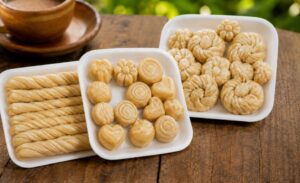

Almojábana is one of Colombia’s most traditional cheese breads, especially associated with Boyacá and Cundinamarca. You make it with fresh curd cheese, cornmeal, eggs, and a little sugar, creating a golden bun with a tender center and a distinct dairy flavor.
People often enjoy it freshly baked for breakfast or the afternoon snack known as onces, alongside hot chocolate, coffee, or a warm panela drink. In the Colombian highlands, almojábanas are an essential part of family bakeries and roadside food stops.
Print
Colombian Almojábana
- Prep Time: 20 minutes
- Cook Time: 25 minutes
- Total Time: 45 minutes
- Yield: 12
- Category: Dessert
- Cuisine: Colombian
Ingredients
- 500 g fresh curd cheese, crumbled (4 cups)
- 150 g pre-cooked white cornmeal (1 cup)
- 50 g cornstarch (⅓ cup)
- 50 g granulated sugar (¼ cup)
- 10 g baking powder (2 teaspoons)
- 3 g salt (½ teaspoon)
- 2 large eggs
- 60 ml whole milk (¼ cup)
- 30 g unsalted butter, melted (2 tablespoons)
Preparation
- Preheat the oven to 200 °C / 400 °F and line a baking sheet with parchment paper or lightly grease it with butter.
- Mix the dry ingredients, place the cornmeal, cornstarch, sugar, baking powder, and salt in a large bowl. Stir until they are evenly combined.
- Make the dough, add the crumbled curd cheese, eggs, and melted butter. Knead with your hands and gradually add the milk until you have a soft, moist dough that is easy to shape. It should hold together without becoming sticky.
- Shape the almojábanas, divide the dough into 12 equal portions and roll them into smooth balls. Place them on the baking sheet, leaving a few inches of space between each one.
- Bake for 20 to 25 minutes, until the almojábanas are puffed, firm, and lightly golden on top and underneath.
- Let them rest for 5 minutes before serving. Enjoy them warm to appreciate their soft texture and fresh cheese aroma.
Chef’s tips
- Use fresh curd cheese rather than aged cheese for the most traditional texture.
- Add the milk gradually because the moisture level of the cheese can vary.
- Do not overwork the dough; knead only until it comes together.
- Serve the almojábanas fresh from the oven, when they are at their softest and most fragrant.
Traditional variations
In some parts of Boyacá and Cundinamarca, people make a simpler version with fresh curd cheese, cornmeal, sugar, salt, and warm water. Other bakeries add cornstarch, eggs, milk, and butter for a softer, more airy result.
How to serve
Serve almojábanas warm, either whole or split in half. Traditionally, you can pair them with Colombian hot chocolate, black coffee, hot panela drink, or warm milk.
Recommended accompaniments
- Colombian hot chocolate
- Colombian black coffee
- Hot panela drink
- Warm milk
- Fresh farmer’s cheese
A little history
Colombian almojábana belongs to a longstanding tradition of baked goods made with corn and dairy products. Its name has ancient roots connected to cheese-based foods from Arabic and Spanish cooking, but in Colombia it developed its own identity through the use of fresh curd cheese and cornmeal.
Although you can find it throughout the country, almojábanas from Boyacá, Cundinamarca, and Soacha are particularly well known in Colombian food culture.
Frequently Asked Questions
Colombian almojábana is mainly made with fresh curd cheese or soft fresh cheese and cornmeal. Pandebono usually contains sour cassava starch, cheese, and often cornmeal. For that reason, pandebono has a chewier texture, while almojábana is softer, more dairy-forward, and closer to a tender cheese bun.
Yes. Use fresh, moist farmer’s cheese when curd cheese is unavailable. Avoid cheese that is very salty, dry, or aged because it can change the flavor and make the dough too dry. Crumble or finely grate the cheese before mixing it with the other ingredients.
The dough can crumble when the curd cheese is too dry or when it needs more liquid. Add milk one tablespoon at a time until you can form smooth balls. The dough should be moist and compact, never sticky or runny.
Let them cool completely, then store them in an airtight container for up to 2 days. To warm them, place them in a 160 °C / 325 °F oven for 5 to 7 minutes. This restores some of their softness without drying them out too much.