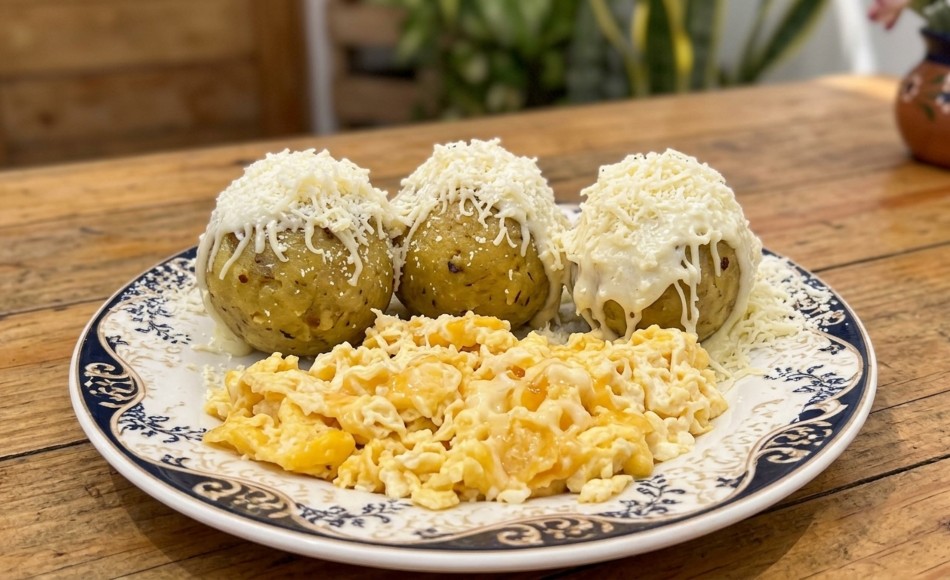
Cabeza de gato is a traditional dish from Colombia’s Caribbean coast made with boiled and mashed green plantains. It is especially popular for breakfast, served with hogao, Colombian costeño cheese, butter, and often suero costeño, a tangy dairy sauce.
Although it resembles cayeye, cabeza de gato is traditionally made with green plantains, while cayeye is more closely associated with green bananas in Colombia’s Magdalena region. The mash should not be completely smooth; small pieces of plantain give it its rustic, home-style texture.
Print
Colombian Cabeza de Gato
- Prep Time: 20 minutes
- Cook Time: 30 minutes
- Total Time: 50 minutes
- Yield: 4
- Category: Main Course
- Cuisine: Colombian
Ingredients
- 1 kg green plantains (4 large plantains)
- 2 l water (8 cups)
- 8 g salt (1 1/2 teaspoons)
- 40 g butter (3 tablespoons)
- 30 ml vegetable oil (2 tablespoons)
- 120 g white onion, finely chopped (1 medium onion)
- 100 g ripe tomato, finely chopped (1 large tomato)
- 10 g garlic, minced (2 cloves)
- 4 g annatto powder or Colombian color seasoning (1 teaspoon)
- 1 g ground black pepper (1/4 teaspoon)
- 120 ml reserved cooking water (1/2 cup)
- 150 g Colombian costeño cheese, grated or crumbled (1 1/4 cups)
- 120 ml suero costeño (1/2 cup)
Preparation
- Cook the plantains, peel the green plantains and cut them into 5 cm pieces. Place them in a pot with the water and 5 g of salt. Cook over medium heat for 20 to 25 minutes, until very tender when pierced. Reserve 120 ml of the cooking water, then drain the plantains.
- Make the hogao, heat the oil in a skillet over medium heat. Add the onion and garlic and cook for 3 minutes, until softened. Add the tomato, annatto powder, remaining 3 g of salt, and black pepper. Cook for 8 minutes, until you have a thick sauce.
- Mash the plantains, place the hot plantains in a large bowl. Add the butter and reserved cooking water gradually while mashing with a wooden masher, potato masher, or fork. The mixture should be soft and moist, with a few small pieces remaining.
- Build the flavor, add half of the hogao and 100 g of the costeño cheese to the mashed plantains. Mix gently until evenly combined. Taste and adjust the salt only if needed, since costeño cheese can be quite salty.
- Serve Caribbean-style, divide the hot mash among four plates. Spoon the remaining hogao over the top, add the remaining 50 g of cheese, and finish with suero costeño.
Chef’s tips
- Use very green plantains; ripe plantains make the dish sweet and change its traditional texture.
- Mash the plantains while hot for the smoothest result.
- Add the cooking water gradually. The mash should be moist, never runny.
- Taste before adding more salt because Colombian costeño cheese is naturally salty.
Traditional variations
Some Caribbean Colombian households add chopped crispy pork, shredded beef, or scrambled eggs. The hogao may be stirred directly into the mash or spooned over it at the table. Costeño cheese and suero are common traditional accompaniments.
How to serve
Serve cabeza de gato immediately with grated costeño cheese and suero costeño. For a traditional breakfast, pair it with a fried egg and Colombian coffee. It also works well alongside fried fish, shredded beef, or crispy pork.
Recommended sides
- Fried egg.
- Suero costeño.
- Grated costeño cheese.
- Shredded beef.
- Fried fish.
- Colombian coffee or fresh juice.
Food culture note
Cabeza de gato belongs to a broad Caribbean tradition of boiled and mashed green plantain dishes. In Colombia, it became a coastal breakfast closely linked to hogao, costeño cheese, and suero, three flavors strongly associated with the region’s everyday cooking.
Frequently Asked Questions
The main difference is the base ingredient. Cabeza de gato uses green plantains, while traditional cayeye uses green bananas. Both may be mashed with butter, cheese, and suero, but plantains give cabeza de gato a firmer texture and a more pronounced flavor.
Yes. You can make a simple version by mashing cooked green plantains with butter, salt, costeño cheese, and a little cooking water. However, the tomato-and-onion hogao adds the familiar Caribbean Colombian flavor and makes the dish more moist and satisfying.
Reserve some cooking water before draining the plantains and add it gradually as you mash. Butter also helps create a softer texture. Do not let the plantains cool for too long before mashing them, since they become firmer and need more liquid.
Yes. Store it in an airtight container in the refrigerator for up to two days. To reheat, add 30 ml of water or milk per serving and warm over low heat while stirring until soft again. Add fresh cheese and suero only when you are ready to serve.