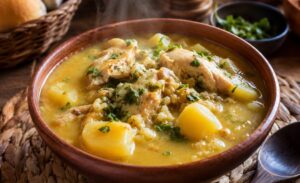
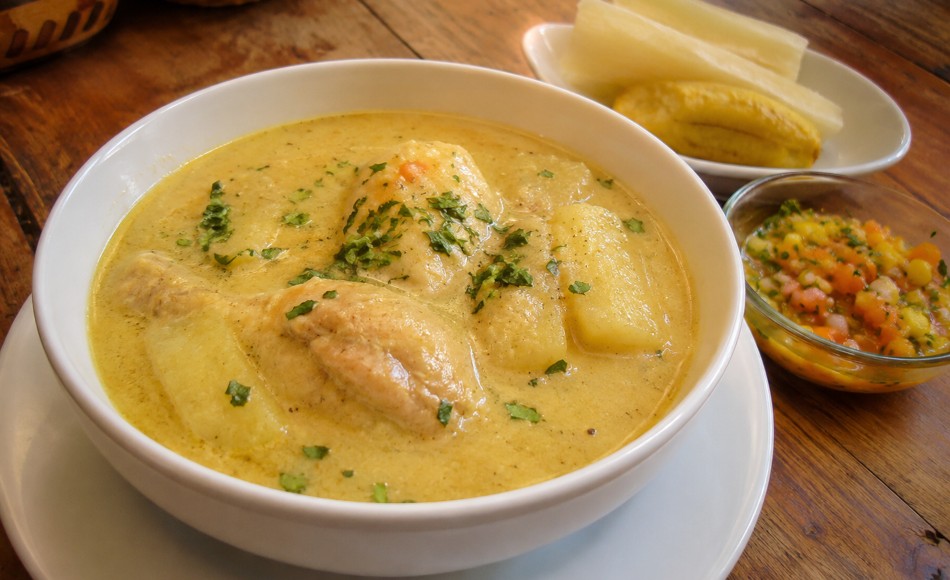
Inchicapi is a traditional soup from the Peruvian Amazon made with hen, ground peanuts, corn, cassava, and aromatic herbs such as sachaculantro. Its name comes from Quechua words associated with peanuts, the central ingredient of this recipe, which gives the soup body, deep flavor, and a slightly thick texture.
It is a highly representative dish in regions such as San Martín, Loreto, Ucayali, and Madre de Dios, where it is served at family lunches, community gatherings, and regional celebrations. Unlike lighter soups, inchicapi is hearty and comforting, ideal for sharing on workdays, patron saint festivities, or Sunday meals.
The most recognized traditional version is made with free-range hen, raw ground peanuts, yellow corn or fresh corn kernels, cassava, and sachaculantro. Its flavor combines the richness of hen, the Amazonian aroma of herbs, and the natural creaminess of peanuts, without dairy or modern thickeners.
Print
Peruvian Inchicapi
- Prep Time: 25 minutes
- Cook Time: 1 hour 30 minutes
- Total Time: 1 hour 55 minutes
- Yield: 6
- Category: Soup
- Cuisine: Peruvian
Ingredients
- 1.2 kg hen, cut into pieces (1 small hen, portioned)
- 2 liters water (8 cups)
- 250 g raw peeled peanuts (1½ cups)
- 200 g peeled yellow corn or fresh corn kernels (1½ cups)
- 500 g peeled cassava, cut into chunks (3 cups)
- 120 g finely chopped red onion (1 medium onion)
- 20 g minced garlic (4 cloves)
- 25 g chopped sachaculantro or fresh cilantro (½ cup)
- 30 ml vegetable oil (2 tablespoons)
- 10 g salt (2 teaspoons)
- 2 g ground cumin (½ teaspoon)
- 2 g ground black pepper (½ teaspoon)
Preparation
- Cook the hen, place the hen pieces in a large pot with the water and half of the salt. Cook over medium heat for 50 to 60 minutes, skimming the foam from the surface when needed, until the meat begins to soften and the broth develops good flavor.
- Grind the peanuts and corn, place the raw peanuts and corn in a blender with 500 ml of hot broth from the pot. Blend until you get a thick mixture that is as smooth as possible. If using dried peeled corn, soak it for several hours beforehand so it blends better and cooks evenly.
- Make the seasoning base, heat the oil in a skillet and sauté the onion with the garlic until soft and fragrant. Add the cumin and black pepper, mix well, and cook for a few more minutes so the seasoning becomes aromatic without burning.
- Build the inchicapi base, add the seasoning base to the pot with the hen and pour in the blended peanut and corn mixture, stirring constantly to prevent it from sticking to the bottom. Cook over medium-low heat for 20 minutes, until the soup begins to thicken and the peanuts lose their raw flavor.
- Add the cassava, add the cassava chunks and continue cooking for 20 to 25 minutes, until they are tender but not falling apart. Stir occasionally and gently, because the peanuts tend to settle and can stick if the heat is too high.
- Adjust and finish, add the chopped sachaculantro, taste for salt, and cook for 5 more minutes so the herb releases its aroma. The soup should be creamy, with a thick but pourable broth, tender pieces of hen, and soft cassava.
- Serve hot, place one piece of hen and cassava chunks in each deep bowl, cover with the hot peanut broth, and serve immediately. Inchicapi is best enjoyed freshly made, when the sachaculantro aroma is present and the broth still has a silky texture.
Practical Tips
Use free-range hen for a more traditional flavor, although it will need more cooking time than regular chicken.
Blend the peanuts very well with hot broth so the soup turns creamy rather than grainy.
Cook the peanut mixture over medium-low heat and stir often, because it can easily stick to the bottom of the pot.
Sachaculantro gives the most characteristic Amazonian aroma; if you cannot find it, use fresh cilantro, though the flavor will be milder.
Do not let the soup become too thick: inchicapi should have body, but it should still be a spoonable soup.
Traditional Variations
In some areas of San Martín, inchicapi is made with farm-raised hen and ground yellow corn, resulting in a more rustic and thicker soup.
In Loreto and other Amazonian regions, it may be prepared with fresh corn kernels when dried peeled corn is not used.
Some families add more cassava to make it a heartier dish, especially when served as the main meal.
There are also home-style versions where the peanuts are ground on a batán or in a mill, giving the soup a more traditional texture than a blender.
Traditional Serving Style
Serve inchicapi very hot in a deep bowl, with one piece of hen, chunks of cassava, and plenty of thick peanut broth. The traditional presentation is simple and generous, meant to be a complete meal.
In the Peruvian Amazon, it is often served with cocona chili sauce, roasted plantain, or extra boiled cassava. For drinks, it pairs well with camu camu juice, aguajina, cocona juice, or masato, depending on regional custom.
Recommended Pairings
- Cocona chili sauce
- Roasted plantain
- Extra boiled cassava
- White rice, in some family tables
- Chonta salad
- Camu camu juice
- Aguajina
- Masato
Origin and Tradition
Inchicapi is one of the oldest and most recognized soups in Peruvian Amazonian cuisine. Its peanut base shows the importance of this ingredient in regional food, not merely as a complement, but as an element capable of thickening, nourishing, and giving deep flavor to a complete preparation.
In many Amazonian families, inchicapi is associated with gatherings and patient cooking. The hen must slowly release its flavor, the peanuts must cook properly, and the cassava must turn tender, creating a soup that expresses abundance, home, and tradition.
Frequently Asked Questions
Peruvian inchicapi is a traditional Amazonian soup made with hen, ground peanuts, corn, cassava, and sachaculantro. It has a creamy texture and deep flavor thanks to the peanuts and hen broth. It is especially popular in regions such as San Martín, Loreto, Ucayali, and Madre de Dios.
The traditional version is made with hen, preferably free-range, because it gives a richer broth and more flavorful meat. It can also be made with chicken if you want a faster cooking time, but the result will be milder and less deep than traditional Amazonian inchicapi.
Peanuts are the ingredient that gives inchicapi its identity. When ground and cooked into the broth, they naturally thicken the soup and add flavor, body, and a creamy texture. It is important to cook them well so they lose their raw taste and blend properly with the hen and cassava.
The most traditional herb is sachaculantro, widely used in Peruvian Amazonian cooking for its intense aroma. If you cannot find it, fresh cilantro is a practical substitute, although the flavor will be less deep. It is best added near the end to preserve its aroma.
Inchicapi is often served on its own as a main soup because it already contains hen, cassava, peanuts, and corn. It can also be accompanied by cocona chili sauce, roasted plantain, extra boiled cassava, or chonta salad. In some family meals, it is served with white rice, although it is not essential.