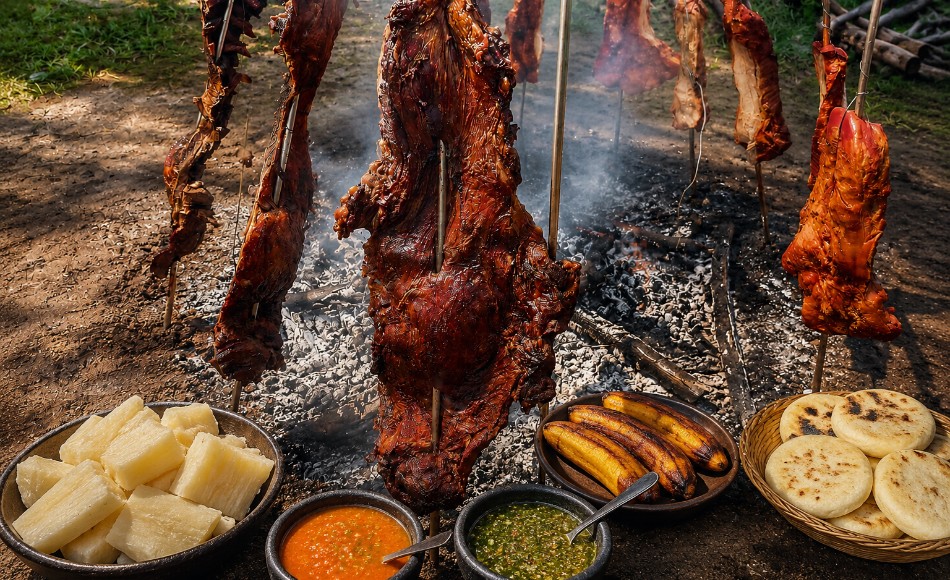
Colombian Llanero Barbecue is one of the most iconic culinary traditions of Colombia’s Eastern Plains. Large cuts of beef are mounted on wooden stakes and slowly roasted around hardwood embers for several hours, creating a unique flavor and texture.
This cooking method originated among Llanero cattle ranchers and remains an essential part of festivals, family gatherings, and cultural celebrations throughout the regions of Meta, Casanare, Arauca, and Vichada.
Traditional preparation uses minimal seasoning to emphasize the quality of the beef and the distinctive smoky flavor produced by slow roasting over wood embers.
Print
Colombian Llanero Barbecue
- Prep Time: 1 hour
- Cook Time: 2 hours 45 minutes
- Total Time: 4 hours 40 minutes
- Yield: 5
- Category: Main Course
- Cuisine: Colombian
Ingredients
- 5 kg beef cuts suitable for Llanero barbecue (ribs, rump cap, loin, flank, and leg)
- 50 g coarse salt (5 tablespoons)
Preparation
- Prepare the meat, trim only excess fat and divide the beef into large pieces suitable for mounting on roasting stakes.
- Season the beef, coat all surfaces with coarse salt and let the meat rest for 30 to 60 minutes.
- Prepare the embers, burn hardwood until a large bed of steady embers forms with minimal flames.
- Mount the meat, secure the cuts onto stakes positioned at an angle around the fire, keeping them at an angle of approximately 45 degrees to the embers, over low, indirect heat.
- Roast slowly, cook for about 1.5 to 4 hours depending on the thickness of the cuts and the intensity of the fire, turning occasionally to ensure even browning.
- Check doneness, remove the meat when it is deeply browned on the outside and tender inside, and let it rest for 10 minutes.
- Slice and serve, carve the different cuts and serve immediately while hot and juicy.
Chef’s Tips
- Use hardwood for long-lasting embers.
- Maintain a consistent roasting temperature.
- Avoid placing the meat too close to the fire.
- Bone-in cuts provide additional flavor.
- Coarse salt is usually all that is needed for authentic flavor.
Traditional Variations
- “Mamona” and “carne a la llanera” are other regional names commonly used for this same traditional stake-roasting preparation.
- In some areas, a home-grill version is prepared with a garlic, herb, and citrus marinade, distinct from the traditional stake-and-hardwood-fire technique.
How to Serve
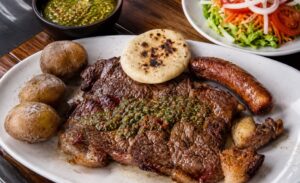
Serve on large platters with boiled cassava, salted potatoes, roasted sweet plantains, corn arepas, and traditional Llanero hot sauce. It is typically shared among a group of family and friends.
Recommended Side Dishes
- Boiled cassava
- Colombian salted potatoes
- Roasted sweet plantains
- Corn arepas
- Llanero hot sauce
- Fresh tomato and onion salad
Food History
Llanero barbecue developed from the traditions of cattle ranchers in Colombia’s Eastern Plains. The stake-roasting technique allowed large quantities of meat to be cooked outdoors during long working days on ranches.
Today it is one of the strongest culinary symbols of the Llanero culture and an important attraction at regional festivals and celebrations.
Frequently Asked Questions
None substantial: these are names commonly used interchangeably for the same traditional stake-roasting technique over hardwood embers, native to Colombia’s Eastern Plains.
Hardwoods that produce steady, long-lasting embers are preferred for authentic preparation.
Yes. Indirect grilling can produce similar results, although it does not fully replicate the traditional stake-roasting method.
Cooking usually requires between 1.5 and 4 hours depending on the thickness of the cuts and the heat level.
Ribs, rump cap, flank, loin, and leg are among the most traditional cuts.