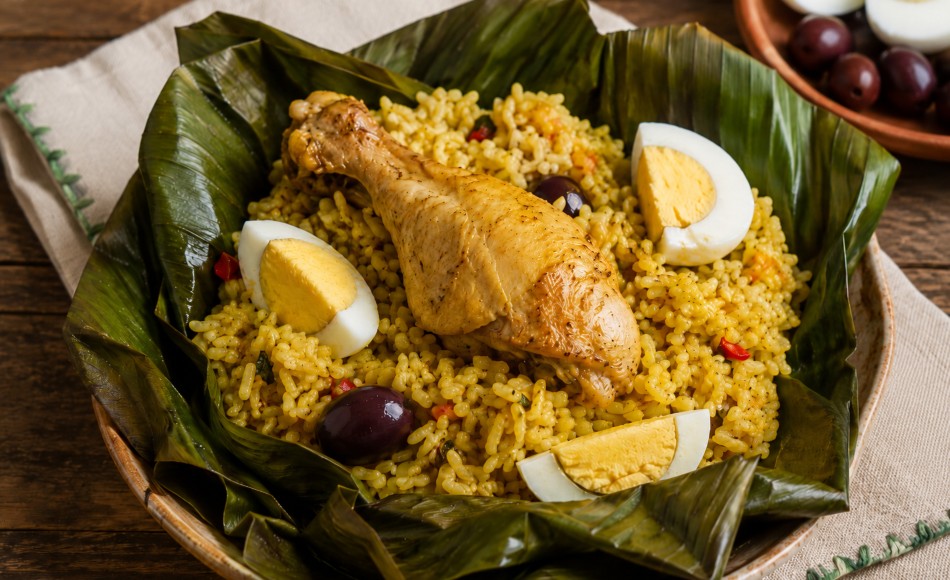
Juane is one of the most iconic dishes of Peru’s Amazon region. Its classic version combines yellow seasoned rice, a piece of hen or chicken, hard-boiled egg, and an olive, all wrapped in bijao leaves and cooked in water. It is the dish most closely associated with the Festival of San Juan, celebrated every June 24 throughout the Peruvian rainforest.
Bijao leaves do more than hold the filling together: they add aroma, keep the rice moist, and make the dish easy to carry. That is why juanes are commonly prepared for travel, outings, family gatherings, and local festivities in regions such as San Martín, Loreto, and Ucayali.
Print
Peruvian Juane
- Prep Time: 45 minutes
- Cook Time: 1 hour 20 minutes
- Total Time: 2 hours 5 minutes
- Yield: 8
- Category: Main Course
- Cuisine: Peruvian
Ingredients
- 1 kg long-grain rice (5 cups)
- 8 medium hen or chicken pieces (about 1.4 kg)
- 2 liters water for cooking the hen or chicken (8 cups)
- 500 ml chicken cooking broth (2 cups)
- 180 g red onion, finely chopped (1 large onion)
- 20 g garlic, minced or blended (4 cloves)
- 45 g ground palillo or turmeric (3 tablespoons)
- 60 g pork lard (¼ cup)
- 10 g salt (2 teaspoons), or to taste
- 3 g ground black pepper (½ teaspoon)
- 3 g ground cumin (½ teaspoon)
- 5 g dried oregano (1 teaspoon)
- 8 large eggs
- 8 black or botija olives
- 16 large bijao leaves
- 8 pieces kitchen twine or cotton string
- 2 liters water for final cooking (8 cups)
Preparation
- Cook the hen or chicken, place the pieces in a pot with the 2 liters of water and 5 g of salt. Cook over medium heat for 35 to 45 minutes, until the meat is tender. Remove the pieces, reserve 500 ml of the broth, and let the meat cool slightly.
- Cook the eggs and prepare the leaves, boil the eggs for 10 minutes, cool them under cold water, peel them, and cut them in half. Wash the bijao leaves and briefly warm them over a hot griddle or with hot water so they become flexible and do not tear while wrapping.
- Make the seasoning base, melt the pork lard in a wide pot and cook the onion over medium heat until translucent. Add the garlic, palillo, black pepper, cumin, oregano, and the remaining 5 g of salt. Cook for 5 minutes, stirring often, until fragrant and deeply yellow.
- Cook the rice, add the rice to the seasoning base and stir for 2 minutes so it absorbs the flavors. Add the reserved broth and 1.25 liters hot water (5 cups). Cook over medium heat until the rice is almost done, still slightly firm, and without excess liquid. Spread it on a wide tray and let it cool until easy to handle.
- Shape the juanes, place two bijao leaves in a cross shape. Add about 180 g cooked rice in the center, make a small hollow, and place one piece of hen or chicken, half a hard-boiled egg, and one olive inside. Cover with a little more rice, bring the leaves upward, and tie them with twine to form a firm round package.
- Cook the juanes, place the juanes in a large pot with enough water to partially cover them. Cover the pot and cook over medium heat for 30 minutes. Remove carefully, let them rest for 5 minutes, and serve hot or warm while still wrapped in the leaves.
Chef’s Tips
- Use bijao leaves whenever possible; they are the most traditional option and give juane its distinctive aroma.
- Cook the rice only until nearly done before wrapping, since it finishes cooking inside the leaves.
- Do not overfill the juanes, so you can seal them tightly and prevent water from entering during cooking.
- Let the rice cool slightly before forming the packages; this makes the leaves easier to handle.
- When using chicken instead of hen, reduce the first cooking time slightly so the meat does not fall apart.
Traditional Variations
Peru’s Amazon has several kinds of juane. Hen juane with rice, egg, and olive is one of the best-known styles and is closely linked to the Festival of San Juan. Other versions use cassava, fish, smoked pork, or palm heart, depending on the region and family tradition.
How to Serve It
Serve juane still wrapped in its bijao leaves and let each person open it on their plate. Traditionally, it is paired with cocona chile sauce, fried plantains, or patacones.
For drinks, serve chicha de jora, camu camu juice, or a chilled aguaje drink.
Recommended Side Dishes
- Cocona chile sauce
- Patacones or fried plantains
- Cocona and onion salad
- Chicha de jora
- Camu camu juice
Origin and Tradition
Modern juane brings together Amazonian ingredients with items incorporated during the colonial period, including rice, hen, olives, and seasonings. Its preparation is strongly connected to the Festival of San Juan, one of the most important celebrations in Peru’s Amazon region.
Its name is commonly linked to Saint John the Baptist, patron saint of the Peruvian Amazon. During the festival, families and visitors take juanes to rivers, beaches, and community gatherings to share them as a portable celebratory meal.
Frequently Asked Questions
Bijao leaves are the most traditional leaves for Peruvian juane. They are sturdy, flexible, and add a distinctive vegetal aroma during cooking. When bijao leaves are unavailable, you can use large banana leaves, although the flavor will be slightly different. Warm the leaves before wrapping so they do not crack.
No. The rice should be almost cooked, slightly firm, and with very little liquid left before you shape the juanes. It finishes absorbing moisture and flavor during the final cooking stage inside the leaves. Fully cooked rice can become overly soft or compact after the wrapped packages are boiled.
Yes, you can use chicken, especially for a faster preparation. However, hen gives juane a deeper flavor and is very traditional in Amazonian cooking. Use bone-in pieces, such as thighs or drumsticks, so the meat remains juicy through the two cooking stages.
You can keep cooked juanes, still wrapped, in the refrigerator for up to 3 days. Let them cool before placing them in a sealed container. To reheat, steam them for 12 to 15 minutes or warm them gently in a pot with a small amount of water. Avoid overheating so the rice does not dry out.