Aragonese guirlache is a crunchy sweet made from unpeeled toasted almonds bound in caramelized sugar, cooked until it forms a golden slab that gets broken into rough pieces once it cools. It's one of the oldest and most recognized sweets in Aragonese confectionery, showing up on Christmas dessert tables and, above all, during Zaragoza's Fiestas del Pilar every October.
During that festival, street stalls throughout downtown Zaragoza prepare guirlache right out in the open, cracking freshly made slabs in front of passersby — a scene that's become part of the city's festive identity. Outside those dates, it's also common to find it in Aragonese pastry shops year-round, sold as a crunchy almond brittle that families give as gifts or share at the end of a meal.
Print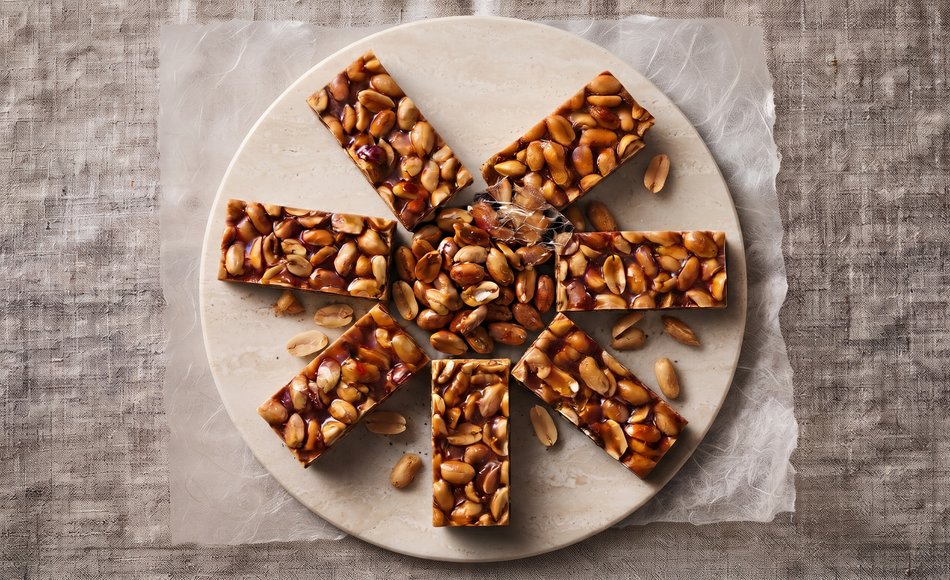
Guirlache (Spanish Almond Brittle)
- Prep Time: 10 minutes
- Cook Time: 20 minutes
- Total Time: 1 hour
- Yield: 10 servings
- Category: Dessert
- Cuisine: Aragonese / Spanish
Ingredients
- 250 g of granulated sugar (1 1/4 cups)
- 250 g of raw unpeeled almonds (skin-on) (1 3/4 cups)
- 60 ml of water (4 tablespoons)
- 5 ml of lemon juice (1 teaspoon)
- 10 ml of sunflower oil or mild olive oil, for greasing the work surface (2 teaspoons)
Preparation
- Toast the almonds, spread the unpeeled almonds in a wide skillet over medium heat and toast for 5 to 7 minutes, stirring constantly, until golden and fragrant; remove from the heat and set aside.
- Prepare your work surface, lightly grease a marble slab, a metal tray, or a sheet of parchment paper with the oil so the guirlache won't stick as it cools.
- Make the caramel, combine the sugar, water, and lemon juice in a heavy-bottomed saucepan and cook over medium heat without stirring, only swirling the pan occasionally, until the sugar fully dissolves and turns a deep golden amber, about 8 to 10 minutes.
- Fold in the almonds, add the toasted almonds to the hot caramel and stir quickly with a wooden spoon until they're evenly coated and distributed throughout.
- Pour and flatten, turn the mixture out onto the greased surface and flatten it right away with the back of a spoon or a greased rolling pin, forming a thin, even slab before the caramel hardens.
- Let it cool and break it, let the guirlache rest at room temperature for at least 30 minutes until completely cool and hard, then break it into irregular pieces or cut it into small bars with a sturdy knife.
Kitchen Tricks
- Don't stir the caramel with a spoon while the sugar is melting; swirl the pan by the handle instead to keep it from crystallizing.
- Use unpeeled almonds — the toasted skin gives guirlache its characteristic slightly bitter edge.
- Have your greased surface and toasted almonds ready before you start the caramel, since you'll need to work fast once it's done.
- If the guirlache turns out too thick, flatten it with a greased rolling pin right after pouring, before it hardens.
Traditional variations
- Some Aragonese pastry shops add a pinch of toasted sesame seeds to the final mixture for extra aroma.
- There's also a version made with hazelnuts instead of almonds, though the unpeeled almond version remains the most representative of Aragón.
Recommended Presentation
Guirlache is traditionally served broken into irregular pieces or cut into small bars, as part of the Christmas dessert spread or Zaragoza's Fiestas del Pilar.
It's usually paired with coffee or a sweet wine at the end of a meal.
Recommended sides
- Black or cortado coffee
- Sweet wine or moscatel
- Soft turrón, as part of a mixed Christmas sweets platter
Origin and Tradition
Guirlache is one of the oldest and most representative sweets of Aragonese confectionery, closely tied to Zaragoza's Fiestas del Pilar every October, where street stalls sell it in freshly broken bars.
Its name comes from the French "grillage," referring to the technique of toasting nuts before mixing them with caramel, a technique that reached Spain through French pastry-making in the 18th century.
Frequently Asked Questions
Stirring it can cause the sugar to crystallize; it's better to just swirl the pan by the handle occasionally.
Because the toasted skin gives guirlache its characteristic slightly bitter edge.
It should rest at room temperature for at least 30 minutes, until completely cool and hard.
A pinch of toasted sesame seeds, as some Aragonese pastry shops do.
With black or cortado coffee, sweet wine or moscatel, or as part of a mixed soft turrón platter.