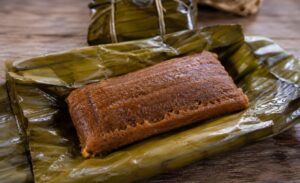

Colombian Caribbean-style tamale, known on the coast as pastel de arroz, is the Caribbean version of the Colombian tamale: instead of corn dough, its base is uncooked rice seasoned with vinegar, achiote oil, and a blended marinade of onion, bell peppers, hot pepper, garlic, and cumin. It is filled with marinated pork ribs, pork belly, and chicken, plus potatoes, carrots, peas, and capers, and cooked wrapped in banana leaves.
On Colombia’s Caribbean coast, this tamale shares its identity with the region’s many leaf-wrapped dishes, where the leaf adds aroma and the cooking concentrates the flavors. Its seasoning is bold, with cumin, color or achiote, and the salty touch of capers.
It is a festive, generous, family dish. Making it is often a shared task: the marinade is blended, the meats are seasoned, the rice is prepared, and the pasteles are assembled one by one, keeping alive a tradition closely tied to home cooking on the coast.
Print
Colombian Caribbean Tamale
- Prep Time: 1 hour
- Cook Time: 2 hours
- Total Time: 6 hours
- Yield: 12 pasteles
- Category: Main Course
- Cuisine: Colombian
Ingredients
For the filling
- 2 pounds pork ribs, cut into small pieces
- 12 chicken pieces
- 1 pound pork belly, cut into small pieces
- 4 medium potatoes, peeled and sliced
- 1 cup diced carrots
- 1 cup peas
- ¼ cup capers
For the marinade
- 2 large onions, chopped
- 4 garlic cloves
- 1 large red bell pepper, chopped
- 1 large green bell pepper, chopped
- 1 teaspoon hot pepper, chopped
- 4 scallions, chopped
- 4 tablespoons ground cumin
- 3 tablespoons sazón with azafrán or color
- Salt
- 2 cups water
For the rice
- 3 cups uncooked white rice
- ½ cup white vinegar
- 2 tablespoons achiote oil
- Salt
- ½ cup of the marinade
For wrapping and cooking
- 2 pounds banana leaves, cut into pieces about 15 inches (38 cm) long
- Kitchen string
- Water and salt for cooking the pasteles
Preparation
- Make the marinade, blend all the marinade ingredients until smooth. Reserve ½ cup for the rice.
- Marinate the meats, place the ribs, chicken, and pork belly in a large bowl and add 1 ½ cups of the marinade. Mix well, cover, and refrigerate overnight or for at least 3 hours.
- Season the rice, mix the uncooked rice with the vinegar, achiote oil, the reserved ½ cup of marinade, and salt, using a wooden spoon or your hands, and let it rest for about 30 minutes. Meanwhile, wash the banana leaves well with hot water.
- Assemble the pasteles, place one piece of leaf on a work surface and lay a second piece on top in the opposite direction, forming a cross. Spread about ¼ cup of the rice mixture in the center where the leaves cross, and top it with 1 piece of pork belly, 1 piece of chicken, and 1 piece of rib. Place 1 tablespoon of peas, 1 tablespoon of carrots, 1 teaspoon of capers, and 2 potato slices over the meat, then cover with about ¼ cup more rice.
- Wrap and tie, fold the leaves up, one of the four sides at a time, until the filling is fully enclosed like a package, and tie with string. Repeat until all the pasteles are wrapped.
- Cook the pasteles, bring a large pot of salted water to a boil, add the pasteles, and reduce the heat to low. Cover and cook for 1 hour and 45 minutes. Remove them from the pot and let them rest for about 5 minutes before cutting the string and serving them in the leaves.
Chef’s Tips
Use bijao leaves if you can find them, since they are prized in coastal cooking and add a special aroma. Otherwise, use well-washed banana leaves.
Go easy on the salt at first, because the capers add a salty touch to the filling.
Marinate the meats overnight, or for at least 3 hours, so they absorb the marinade well.
Distribute the filling evenly, without overloading each pastel, so you can wrap it properly.
Let the pasteles rest for a few minutes before opening them so the rice settles and the filling holds its shape.
Traditional Variations
In some areas of the Caribbean coast, it is made with hen instead of chicken, especially for family or festive occasions.
The leaves can also vary: some households prefer bijao, while others use banana leaves depending on availability and family custom.
Traditional Serving Style
Colombian Caribbean-style tamale is served hot, opened on the same leaf it was cooked in. It is commonly enjoyed as a hearty breakfast, family lunch, or special meal at celebrations.
It is traditionally served with Colombian coffee, hot chocolate, aguapanela, or a typical cold drink from the region, depending on the time of day. It can also be served as a main dish without many sides, since it already contains rice, meats, and vegetables.
Recommended Pairings
- Colombian coffee
- Hot chocolate
- Aguapanela
- Suero costeño, depending on family custom
- Arepa de huevo or white arepa for a hearty breakfast
Food Tradition
Colombian Caribbean-style tamale reflects the coastal way of cooking wrapped dishes: generous, well-seasoned preparations made for sharing. The leaf is not just a wrapper; it also adds aroma and helps the rice stay moist while it cooks.
In many coastal families, pasteles are made in large batches for special occasions. More than an individual recipe, they often represent a day of shared cooking in which everyone takes part in a step of the process.
Frequently Asked Questions
Its base is not corn dough but uncooked rice seasoned with vinegar, achiote oil, and a blended marinade. It is filled with marinated pork ribs, pork belly, and chicken, plus potatoes, carrots, peas, and capers, and cooked wrapped in banana leaves.
Yes. This version uses about 1 teaspoon of capers in each pastel, along with the peas, carrots, and potatoes; they add a characteristic salty touch, so go easy on the salt.
The rice goes in uncooked, mixed with vinegar, achiote oil, salt, and part of the marinade; it cooks inside the leaf while the pasteles boil.
The pasteles go into a pot of already boiling salted water and cook covered over low heat for 1 hour and 45 minutes; then they rest for about 5 minutes before serving.
Yes, you can freeze them after they are cooked and completely cooled. Keep them well wrapped to preserve moisture. To reheat them, steam them or warm them in hot water while still wrapped in the leaf until heated through.