Asturian fabada is the signature dish of Asturias, a lush, green region in northern Spain, built around fabes de la granja — large, tender white beans — slow-simmered with the compango: a mix of cured chorizo, blood sausage (morcilla), cured pork shoulder (lacón), and pork belly that gives the stew its deep, smoky richness.
Though beans arrived in Spain from the Americas after the conquest, Asturias' cool, humid climate turned out to be ideal for growing them, and over generations the dish became the classic Sunday family meal, ladled from a clay pot and eaten slowly, almost always alongside a glass of natural Asturian cider.
Today Asturian fabas even carry a Protected Geographical Indication, and the stew is celebrated at cook-offs and food fairs across the region, making fabada one of Spain's most recognized culinary ambassadors abroad.
Print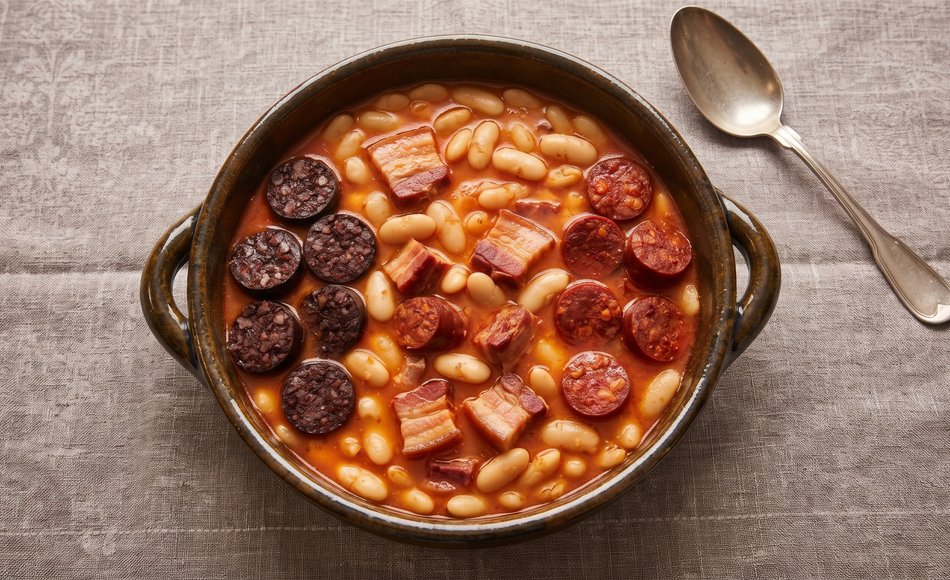
Asturian Fabada (Fabada Asturiana)
- Prep Time: 25 minutes
- Cook Time: 2 hours 30 minutes
- Total Time: 15 hours 10 minutes
- Yield: 6 servings
- Category: Main Course
- Cuisine: Asturian
Ingredients
- 500 g of dried fabes beans (large Asturian white beans) (about 2 ½ cups (or substitute large dried gigante/corona beans))
- 300 g of cured Asturian chorizo (2 chorizo links)
- 300 g of Asturian blood sausage (morcilla) (2 morcilla links)
- 250 g of cured pork shoulder (lacón) (1 piece)
- 150 g of streaky pork belly (panceta) (1 piece)
- 1 smoked ham bone (optional)
- 1 medium white onion, whole and peeled
- 2 garlic cloves, whole and unpeeled
- 1 bay leaf
- A pinch of toasted saffron threads
- Salt, to taste
- 2.5 liters of cold water (about 10 cups)
Preparation
- Soak the beans, place them in a large bowl, cover generously with cold water, and let them soak for at least 12 hours, ideally overnight in the fridge, so they cook evenly without splitting.
- Set up the pot, drain the soaked beans and transfer them to a large, wide pot (ideally clay or heavy steel) along with the pork shoulder, whole onion, garlic cloves, bay leaf, and pork belly, then cover everything with cold water until it sits about two finger-widths above the ingredients.
- Bring to a boil carefully, set the pot over high heat until it reaches a full boil, skimming off the foam that rises to the surface with a slotted spoon, a key step for a clean, clear broth.
- Shock the beans, as soon as it boils, pour in a splash of cold water — the classic Asturian "susto" — and lower the heat to a bare simmer, since this sudden temperature drop keeps the beans from splitting and helps their skins stay intact through the long cooking time.
- Simmer low and slow, partially cover the pot and cook over very low heat for about 2 hours, gently swirling the pot from time to time instead of stirring with a spoon, and making sure the beans stay covered with liquid the whole time.
- Add the chorizo and morcilla, once the beans start turning tender, after roughly 1 hour and 30 minutes of cooking, add the whole chorizo and morcilla links so they finish cooking together with everything else during the last 30 to 40 minutes.
- Finish with saffron and season, dissolve the toasted saffron threads in a bit of hot broth, stir it into the pot along with salt to taste, and cook 10 more minutes, until the beans turn creamy on the outside while staying whole inside and the broth thickens slightly.
- Rest and serve, remove the pot from the heat, let the fabada rest covered for 10 to 15 minutes so the flavors settle, discard the bay leaf, slice the meats, and serve hot in individual earthenware bowls with a portion of each compango meat.
Chef's Tips
- Never stir with a spoon — gently swirl the pot instead so the beans don't break apart.
- Look for authentic fabes de la granja, protected by a Geographical Indication, for the signature creamy texture.
- Keep the heat very low and the lid just barely cracked so the stew simmers gently, never at a hard boil.
- Fabada tastes even better the next day; reheat it gently over low heat before serving.
- Lightly toast the saffron threads before dissolving them in broth to bring out more aroma.
Traditional variations
- Some Asturian households also add pork tail or snout to the compango, alongside the lacón, chorizo, morcilla, and pork belly.
Traditional Serving
Fabada is served hot in individual clay bowls, with the beans well covered in broth and the compango meats sliced, either mixed into the dish or set aside on a plate for each diner to help themselves.
It's customary to serve it with crusty country bread for dipping into the broth and to enjoy it slowly, as the single main course of a Sunday family meal.
Recommended sides
- Crusty Asturian country bread for dipping into the broth
- Natural Asturian cider (sidra)
- A young red wine, in some households
Origin and Tradition
Although it feels inseparable from Asturian identity today, the bean behind fabada actually arrived in Spain from the Americas after the 16th century; it was in Asturias, thanks to its humid climate, that it found the ideal conditions to become a local crop of its own.
Asturian fabas have held a Protected Geographical Indication since 1996, and towns like Villaviciosa hold annual contests to crown the region's best fabada, proof of just how deeply the dish remains woven into Asturian social life.
Frequently Asked Questions
This is the classic Asturian "susto": the sudden temperature drop keeps the beans from splitting and helps their skins stay intact through the long cooking time.
Stirring with a spoon can break the beans apart; instead, gently swirl the pot.
At least 12 hours, ideally overnight in the fridge, so they cook evenly without splitting.
Yes, fabada tastes even better the next day; reheat it gently over low heat before serving.
It is served with crusty country bread for dipping into the broth, traditionally with natural Asturian cider, and in some households with a young red wine.