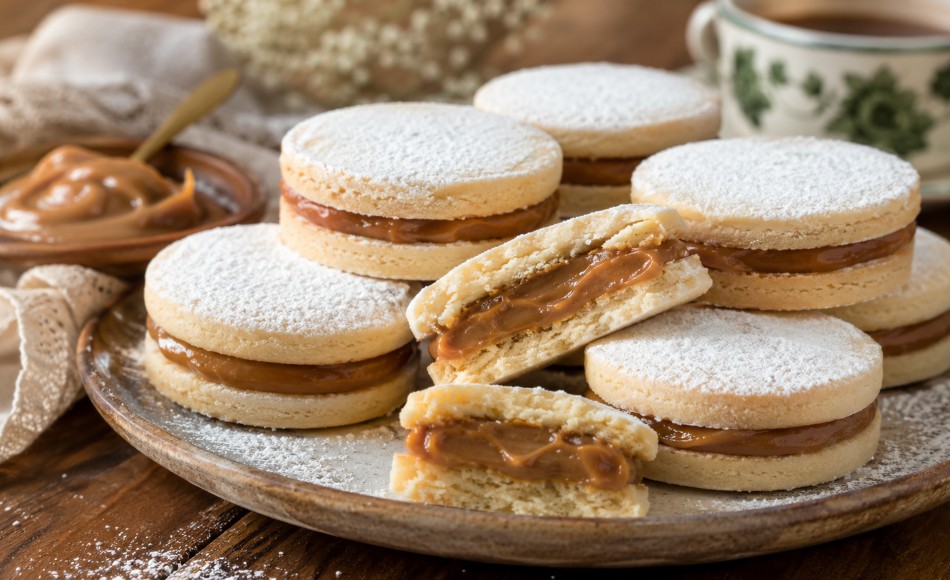
Peruvian alfajores are one of the most beloved sweets in criollo pastry. They are made with two soft, delicate cookies prepared with flour and cornstarch, filled with manjar blanco, and dusted with powdered sugar. Their texture should be tender, slightly sandy, and soft enough to melt when you bite into them.
In Peru, they are classics of bakeries, afternoon snacks, birthdays, dessert tables, and traditional celebrations. Although alfajores exist in many Latin American countries, the Peruvian version is especially known for its generous manjar blanco filling and its pale, thin, very tender cookie layers, more delicate than crunchy.
Print
Peruvian Alfajores
- Prep Time: 35 minutes
- Cook Time: 12 minutes
- Total Time: 47 minutes
- Yield: 18
- Category: Dessert
- Cuisine: Peruvian
Ingredients
Nutrition
- Calories: 185
Ingredients
- 250 g all-purpose flour (2 cups)
- 250 g cornstarch (2 cups)
- 200 g unsalted butter, at room temperature (¾ cup + 2 tablespoons)
- 100 g powdered sugar (¾ cup)
- 3 egg yolks
- 5 ml vanilla extract (1 teaspoon)
- 5 g baking powder (1 teaspoon)
- 2 g salt (½ teaspoon)
- 400 g Peruvian manjar blanco (1½ cups)
- 60 g powdered sugar for dusting (½ cup)
Preparation
- Prepare the dough, beat the butter with the powdered sugar until creamy and smooth. Add the egg yolks one at a time, add the vanilla, and mix until everything is well combined, without overbeating.
- Add the dry ingredients, sift the flour, cornstarch, baking powder, and salt. Add them gradually to the butter mixture and bring the dough together with a spatula or your hands, only until a soft dough forms. Do not overwork it, because the cookies should be delicate and crumbly.
- Rest and roll, wrap the dough and refrigerate it for 30 minutes so it firms up. Roll it out on a lightly floured surface to about 4 mm thick, keeping the thickness even so the cookies bake uniformly.
- Cut and bake, cut circles 5 to 6 cm wide and place them on a baking sheet lined with parchment paper. Bake at 170 °C for 10 to 12 minutes, until the cookies are firm but still pale. They should not brown too much, because traditional Peruvian alfajores keep a light color.
- Fill the alfajores, let the cookies cool completely before moving them. Place a generous teaspoon of manjar blanco on one cookie, cover with another, and press gently so the filling reaches almost to the edge without breaking the cookie.
- Decorate and serve, dust the alfajores with powdered sugar using a fine sieve. Let them rest for a few minutes before serving so the manjar blanco settles and the cookies hold their shape.
Chef’s Tips
Use room-temperature butter, not melted butter. If it is liquid, the dough loses structure and the cookies may spread too much.
Do not knead the dough like bread. Bring the ingredients together only until combined, because too much handling develops gluten and makes the alfajores tough.
Bake the cookies until firm but pale. If they brown too much, they will turn drier and less delicate.
Fill the alfajores only when the cookies are completely cool. If they are warm, the manjar blanco softens and may spill out.
Traditional Variations
In some Peruvian homes, alfajores are made with a higher proportion of cornstarch than flour, which gives them an even softer, more delicate texture.
Small bite-size alfajores are also common on dessert tables for baptisms, birthdays, and family gatherings.
In certain bakeries, the edges are rolled in finely shredded coconut after filling, although the most classic presentation uses only powdered sugar.
Traditional Serving Style
Peruvian alfajores are served at room temperature, dusted with powdered sugar and filled with manjar blanco. They are presented on platters, in sweet boxes, or on trays for sharing during afternoon tea, family celebrations, or criollo dessert tables.
Traditionally, they are served with Peruvian drip coffee, tea, hot chocolate, or a mild herbal infusion. They also pair beautifully with other Peruvian sweets such as mazamorra morada, rice pudding, guargüeros, and suspiro a la limeña.
Recommended Pairings
- Peruvian drip coffee
- Hot tea
- Hot chocolate
- Chamomile or lemongrass infusion
- Mazamorra morada
- Rice pudding
- Suspiro a la limeña
Did You Know?
Alfajores arrived in Peru as part of Spanish pastry heritage, but over time they became a deeply criollo sweet. In the Peruvian version, manjar blanco plays a central role: it is not just a filling, but the flavor that defines the traditional alfajor.
In many families, making alfajores is a celebration recipe. The cookies are baked carefully so they remain pale and tender, then filled one by one and dusted with powdered sugar just before serving or packing.
Frequently Asked Questions
Peruvian alfajores usually have soft, pale, delicate cookies made with flour and cornstarch, and they are filled with manjar blanco. Unlike some crunchier or chocolate-covered versions, the traditional Peruvian alfajor stands out for its fine texture and creamy filling.
You can use dulce de leche if you do not have manjar blanco, but the traditional Peruvian flavor comes from manjar blanco. It usually has a creamy texture and a sweetness that works very well for filling the cookies without overpowering their softness.
They may turn hard if you overwork the dough, add too much flour while rolling, or bake them longer than needed. For a soft texture, handle the dough gently and remove the cookies when they are firm but still light in color.
You can store them in an airtight container at room temperature for 3 to 4 days in a cool, dry place. If the weather is very hot, refrigerate them, but let them sit at room temperature for a few minutes before serving.
Yes. You can bake the cookies one or two days ahead and store them unfilled in an airtight container. Fill them with manjar blanco on the day you plan to serve them so they keep the best texture.