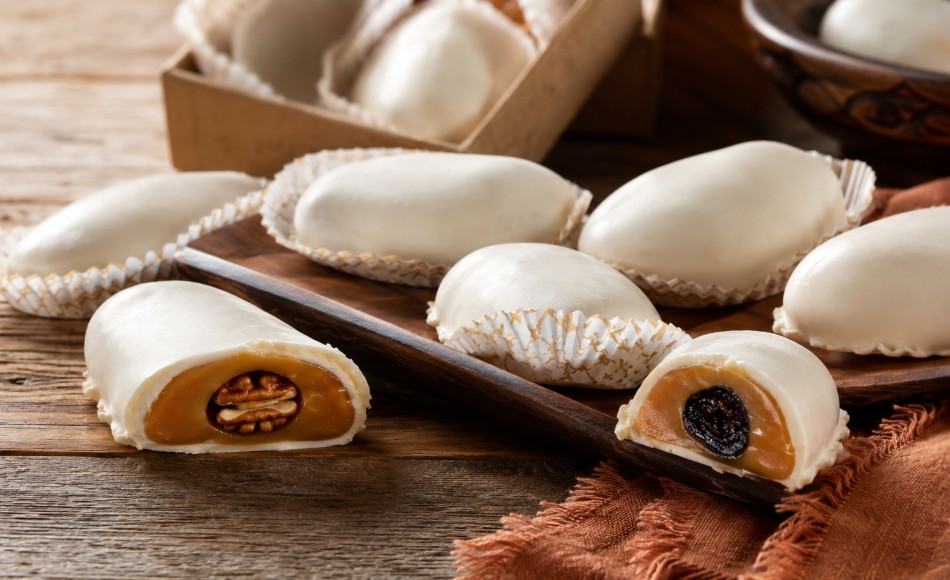
Peruvian tejas from Ica are traditional sweets from the Ica region on Peru’s southern coast. They are made with a filling of manjar blanco and nuts or candied fruit, covered with a white fondant or sugar coating that gives them their characteristic appearance.
They are especially representative of Ica, a region known for its vineyards, piscos, handmade sweets, and pastry tradition. Tejas are often sold in boxes as gifts, travel souvenirs, or celebration sweets, and they are part of Ica’s culinary identity along with other local products.
The most recognized traditional version is made with manjar blanco and pecans, although there are also variations with figs, prunes, candied lemon, or walnuts. This recipe keeps the classic style: a soft sweet center, a nut or candied fruit, and a firm, delicate white coating.
Print
Peruvian Tejas from Ica
- Prep Time: 45 minutes
- Cook Time: 20 minutes
- Total Time: 1 hour 5 minutes
- Yield: 24
- Category: Dessert
- Cuisine: Peruvian
Ingredients
For the filling
- 300 g thick manjar blanco or dulce de leche (1 cup)
- 150 g whole or halved pecans (1½ cups)
- 100 g pitted prunes or candied figs, optional traditional filling (¾ cup)
For the white coating
- 500 g white sugar (2½ cups)
- 120 ml water (½ cup)
- 30 ml lemon juice (2 tablespoons)
- 5 ml vanilla extract (1 teaspoon)
For working
- 20 g powdered sugar (2 tablespoons, for dusting the surface if needed)
- 24 small paper cups or parchment paper for resting the tejas
Preparation
- Prepare the centers, take small portions of thick manjar blanco and wrap a pecan, prune, or piece of candied fig in the center. Shape them into small ovals with lightly moistened hands or a spoon, making sure they are compact and similar in size.
- Rest the filling, place the centers on parchment paper and let them rest for 20 to 30 minutes so they firm up. The manjar should be thick and easy to handle; if it is too soft, refrigerate it briefly before coating.
- Make the syrup, place the sugar and water in a heavy-bottomed pot. Cook over medium heat without stirring too much until the sugar dissolves and the syrup reaches soft-ball stage, about 112 to 115 °C. Add the lemon juice at the end to help the coating stay whiter and more workable.
- Beat the fondant, remove the syrup from the heat, add the vanilla, and let it cool slightly. Then beat it with a wooden spoon or spatula until it changes from clear to opaque white and thickens. It should stay pourable, but thick enough to coat the tejas.
- Coat the tejas, dip each manjar and pecan center into the warm fondant, cover it completely, and lift it out with a fork. Let the excess drip off and place it on parchment paper or in small paper cups. If the fondant hardens, warm it gently over a water bath to make it fluid again.
- Let dry and serve, allow the tejas to rest at room temperature until the coating is firm and dry to the touch. Once ready, place them in paper cups or wrap them individually, as is traditional in Ica-style pastry.
Practical Tips
Use very thick manjar blanco, because a soft filling will lose its shape and make coating difficult.
Work with small portions so the tejas stay delicate and easy to eat.
The syrup stage matters: if it is too thin, it will not coat well; if it goes too far, the fondant will harden too quickly.
Keep the fondant warm while coating the tejas to achieve an even, smooth layer.
Let them dry completely before wrapping so the coating does not stick to the paper.
Traditional Variations
The most classic Ica-style teja is made with pecan and manjar blanco, covered with white fondant.
There are also tejas filled with prunes, candied figs, candied lemon, candied orange, or walnuts, all common in Ica’s traditional sweet-making.
A very well-known modern variation is the chocoteja, which replaces the white coating with chocolate, although the traditional Ica teja is identified by its white sugar coating.
Traditional Serving Style
Serve tejas in small paper cups, sweet boxes, or individually wrapped. The traditional presentation highlights their oval shape, white coating, and manjar blanco filling with a nut or candied fruit.
They are enjoyed as an after-meal sweet, handmade gift, travel souvenir, or coffee accompaniment. In Ica, they also pair well with infusions, brewed coffee, or a small glass of sweet pisco on special occasions.
Recommended Pairings
- Peruvian brewed coffee
- Lemongrass infusion
- Mild black tea
- Sweet pisco or mistela, in a small serving
- Candied fruits
- They can also be served on their own as a traditional Ica sweet
Culinary Curiosity
Tejas are one of Ica’s most representative sweets and are associated with the handmade pastry tradition that many families and local businesses have preserved for generations. Their name is popularly linked to their oval, slightly curved shape, which resembles a small roof tile.
Over time, tejas became a gastronomic souvenir from southern Peru. Visitors to Ica often bring boxes of tejas or chocotejas as gifts, helping spread this sweet throughout the country while preserving its regional identity.
Frequently Asked Questions
Tejas from Ica are traditional Peruvian sweets made with manjar blanco and nuts or candied fruit, covered with a white sugar fondant. The most classic version contains pecans, although fillings such as prunes, figs, candied lemon, or walnuts are also traditional.
A traditional teja has a white sugar or fondant coating, while a chocoteja is covered with chocolate. Both often contain manjar blanco and fillings such as pecans or candied fruit, but the classic Ica teja is recognized by its white coating and handmade origin in Ica.
Thick, firm, well-cooked manjar blanco is used, one that can hold its shape around the pecan or fruit. If the manjar is too runny, the tejas will deform and the coating will not stick properly. A dense, smooth texture is ideal.
Store tejas in a sealed container in a cool, dry place. Avoid exposing them to heat, because the filling may soften and the coating may become sticky. If they are fully dry and protected, they keep well for several days with good texture.
Not always, although pecan tejas are among the most traditional and recognized. They are also made with prunes, candied figs, candied lemon, candied orange, or walnuts. All these variations belong to Ica’s sweet-making tradition, always with manjar blanco and a sweet coating.