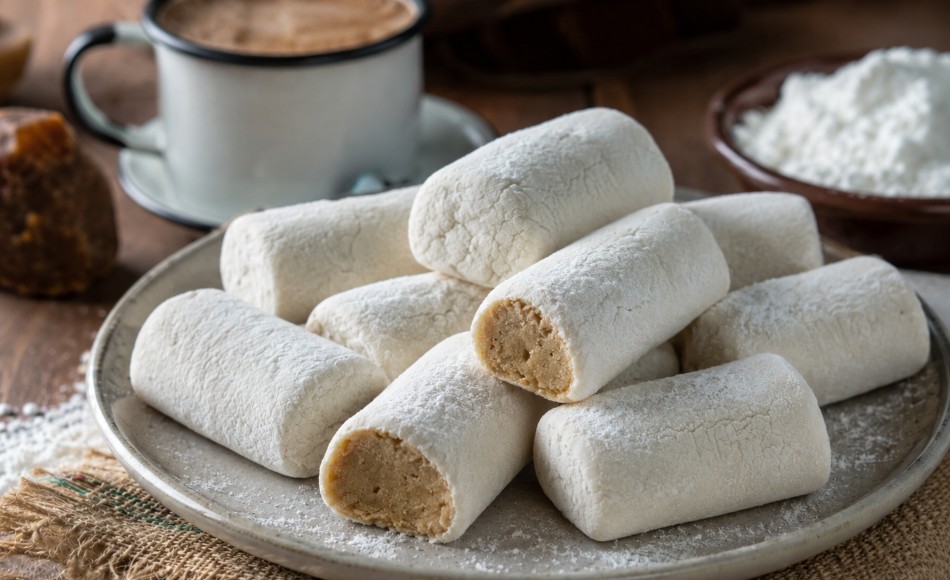
Gelatina de pata is one of Colombia’s best-known artisan sweets. It is made with the natural collagen released by slowly cooking beef feet. In Valle del Cauca, especially in Andalucía, this candy is strongly connected to local confectionery traditions.
The white version is made with panela, milk, cinnamon, and vanilla. The mixture is then beaten until it becomes lighter and airy, before being cut into pieces and lightly coated with cornstarch.
Print
Colombian Gelatina de Pata
- Prep Time: 30 minutes
- Cook Time: 5 hours 30 minutes
- Total Time: 6 hours
- Yield: 20
- Category: Dessert
- Cuisine: Colombian
Ingredients
Nutrition
- Calories: 185
Ingredients
- 1.5 kg cleaned, cut beef feet
- 4 l water (16 cups)
- 1.5 kg panela, grated or broken into small pieces
- 500 ml whole milk (2 cups)
- 10 ml vanilla extract (2 teaspoons)
- 2 cinnamon sticks
- 4 whole cloves
- 80 g cornstarch (⅔ cup), for dusting
Preparation
- Cook the beef feet, place the cleaned beef feet in a large pot with the water. Cook over medium-low heat for 4 to 5 hours, until the bones are clean and the cooled broth feels slightly sticky between your fingers.
- Strain the broth, remove the bones and strain the liquid through a fine sieve. Let it settle briefly, then skim off any fat from the surface. Reserve 2 l concentrated broth (8 cups).
- Make the sweet base, return the broth to a clean pot with the panela, cinnamon sticks, and cloves. Cook over medium heat for 35 to 45 minutes, stirring occasionally, until the panela dissolves and the liquid becomes more concentrated.
- Add the flavorings, remove the cinnamon and cloves. Add the milk and vanilla, stir well, and cook over low heat for 8 more minutes until the mixture is smooth and thick.
- Beat the gelatina, transfer the warm mixture to a wide bowl and beat continuously with a sturdy whisk or wooden spoon for 12 to 15 minutes, until it becomes lighter, thicker, and airy.
- Shape and set, dust a rectangular dish with part of the cornstarch, pour in the mixture, and smooth the surface. Dust lightly with more cornstarch and let it rest at room temperature for 6 hours, until firm.
- Cut and serve, unmold the candy onto a board, cut it into squares or bars, and coat the pieces lightly with additional cornstarch before serving.
Chef’s Tips
- Ask your butcher for beef feet that are already cleaned and cut.
- The broth must be concentrated because it is the natural setting base of the dessert.
- Beat the mixture while warm; once cold, it becomes harder to work with.
- Use only a light coating of cornstarch so it does not overpower the flavor.
Traditional Variations
Black gelatina de pata keeps panela’s deep brown color and is usually molded with minimal beating. White gelatina de pata is beaten longer to create a lighter, airier candy and is often finished with cornstarch.
How to Serve
Serve gelatina de pata at room temperature in small squares or bars, lightly dusted with cornstarch. It is traditionally enjoyed as an afternoon sweet at fairs, markets, and traditional candy stalls.
Pair it with Colombian coffee, hot chocolate, or milk.
Recommended Accompaniments
- Colombian coffee
- Hot chocolate
- Warm milk
- Herbal tea
Did You Know?
Gelatina de pata does not rely on commercial gelatin. Its firm texture comes from the collagen released during the long cooking process. Beating the warm mixture is what transforms the darker syrup into a lighter, softer candy.
Frequently Asked Questions
This usually happens when the broth is not concentrated enough or when too much water remains in the final mixture. Cook the beef feet for several hours and make sure the broth feels slightly sticky once cooled. The resting time is also important for the dessert to firm up properly.
Black gelatina de pata keeps the deep color of panela and is often molded directly. White gelatina de pata is beaten for several minutes to add air, lighten the color, and create a softer texture. Both versions begin with concentrated broth made from beef feet.
Keep it in an airtight container, separating the pieces with parchment paper or cornstarch. Store it in a cool place for up to 2 days or refrigerate it for up to 5 days. Let it sit at room temperature for a few minutes before serving.