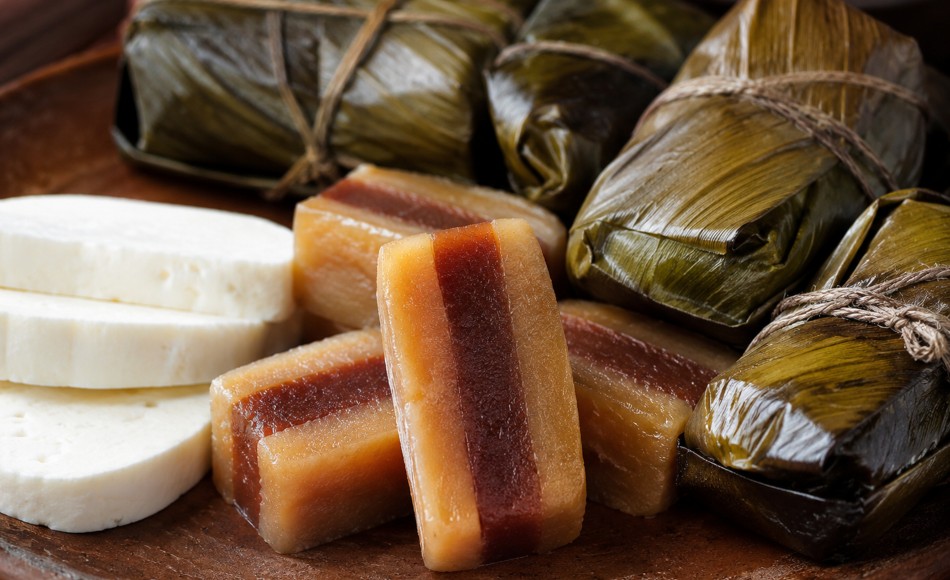
Bocadillo veleño is one of the most iconic sweets from Santander, Colombia. Its traditional style is made by slowly cooking red and white guava pulp with sugar until it becomes a firm, glossy, fragrant guava paste. The best-known presentation has a red center layer framed by two pale outer layers.
The original product from the Vélez region is also known for being individually wrapped in bijao leaves, which help protect the candy and give it a distinctive aroma. Colombia’s Superintendence of Industry and Commerce describes bocadillo veleño as a firm guava sweet with red and white layers and the aroma of ripe guava and bijao.
Print
Colombian Bocadillo Veleño
- Prep Time: 45 minutes
- Cook Time: 1 hour 30 minutes
- Total Time: 2 hours 15 minutes
- Yield: 24
- Category: Dessert
- Cuisine: Colombian
Ingredients
- 800 g seedless red guava pulp, from about 1.2 kg ripe red guavas
- 700 g granulated sugar (3½ cups)
For the pale layers
- 800 g seedless white guava pulp, from about 1.2 kg ripe white guavas
- 700 g granulated sugar (3½ cups)
For wrapping
- 24 clean, dried bijao leaves, cut into rectangles about 15 x 12 cm
Preparation
- Prepare the guava pulps, wash the red and white guavas separately, cut them into large pieces, and cook them in two separate pots over low heat until very soft and juicy. Pass each batch through a fine sieve or food mill to remove the seeds, then measure 800 g of each pulp.
- Cook the red paste, place the red guava pulp and 700 g sugar in a wide heavy-bottomed pot. Cook over medium-low heat, stirring constantly with a wooden spoon, until thick, glossy, and difficult to move across the bottom of the pot, about 35 to 45 minutes.
- Make the center layer, pour the hot red guava paste into a 20 x 30 cm rectangular pan lined with parchment paper. Spread it into an even layer about 1.5 cm thick and let it rest while you cook the pale guava paste.
- Cook the pale paste, place the white guava pulp and the remaining 700 g sugar in another heavy-bottomed pot. Cook while stirring constantly for 35 to 45 minutes, until you have a thick, firm, smooth paste that holds the mark of a spoon.
- Build the layers, spread half of the pale guava paste over the still-warm red layer. Let it rest for 10 minutes to set slightly, carefully turn the block onto another parchment-lined tray, and cover the other side with the remaining pale guava paste. Let it cool completely at room temperature.
- Cut and wrap, let the bocadillo rest for 8 hours or overnight so it firms up. Cut it into small rectangles, about 5 x 3 cm, and wrap each piece in a clean bijao leaf before storing.
Chef’s tips
- Use ripe, fragrant guavas for the brightest color and fullest flavor.
- Cook the red and white guava pulps separately to preserve the dessert’s classic layered appearance.
- Stir continuously during the final stage because the thick paste can stick and scorch quickly.
- The paste is ready when a spoon leaves a trail that closes slowly.
- Let the candy rest completely before cutting for neat, firm pieces.
Traditional variations
The most representative version has a red guava center with two white guava outer layers. Colombia also has single-layer guava pastes, but they do not have the distinctive three-layer appearance traditionally associated with bocadillo veleño.
How to serve
Serve bocadillo veleño in small portions, still wrapped in bijao leaves or unwrapped just before eating. In Colombia, it is especially popular with queso campesino or fresh farmer cheese, a classic sweet-and-salty pairing.
Recommended pairings
- Queso campesino
- Fresh farmer cheese
- Black Colombian coffee
- Hot chocolate
- Rustic bread or almojábanas
A little history
Bocadillo veleño is closely tied to the Vélez province in Santander. Its identity comes from the combination of red and white guava, sugar, and individual bijao-leaf wrapping. The sweet is associated with methods of production passed down through generations in this Colombian region.
Frequently Asked Questions
The classic presentation uses red guava for the center and white guava for the outer layers. This combination creates bocadillo veleño’s recognizable appearance while also adding subtle differences in flavor and aroma. Cook the two pulps separately and assemble the layers only after both mixtures have thickened properly.
Yes, you can make homemade guava paste using only red guava. However, it will not have the classic look of traditional bocadillo veleño, which is known for its red center layer between two pale white-guava layers.
Store it in an airtight container in a cool, dry place for 2 to 3 weeks. In very warm or humid weather, refrigerate it to help it stay firm. Keep the pieces wrapped in bijao leaves or parchment paper so they do not stick together.
Yes, you can use parchment paper or store the candy in an airtight container. However, bijao leaves are an important part of the traditional presentation and provide the characteristic aroma associated with the original product.