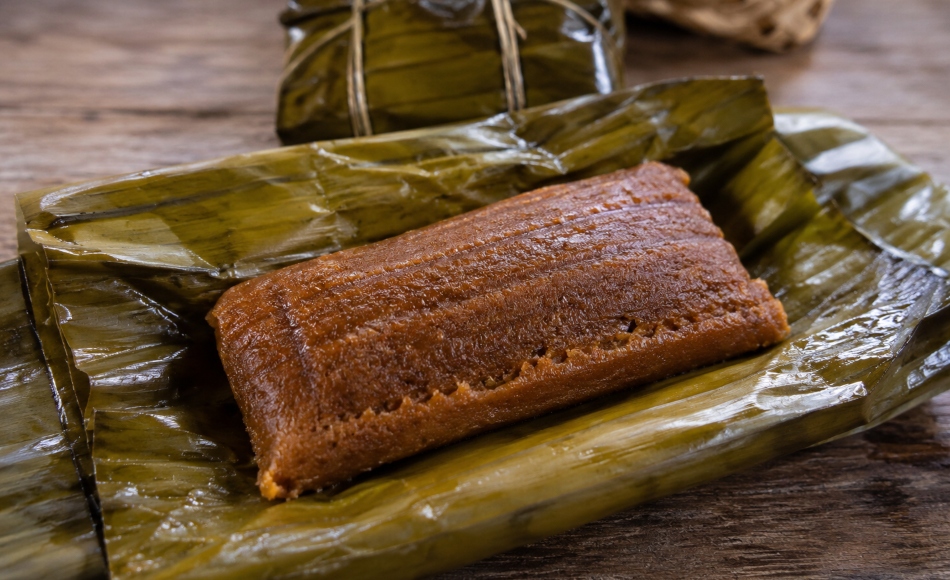
Insulso is a traditional leaf-wrapped dish from the Greater Tolima region (Tolima and Huila) made with corn flour cooked in an aguapanela spiced with cinnamon, cloves, and guayabita, wrapped in banana leaves, and baked in the oven. It is the main accompaniment to the region’s meals, especially Tolima-style lechona.
Unlike steamed wraps, insulso is first cooked in a pot until thick and then slowly baked in the leaf, which gives it a firm, slightly compact texture and a sweet flavor defined by the panela and spices.
Many families make it for celebrations, outings, large gatherings, or weekend meals. Its value lies in its simplicity: few ingredients, good technique, and patient cooking to achieve a sweet, aromatic dough.
Print
Colombian Insulso
- Prep Time: 30 minutes
- Cook Time: 3 hours 15 minutes
- Total Time: 4 hours
- Yield: 10 to 15 insulsos
- Category: Side Dish
- Cuisine: Colombian
Ingredients
- 500 g corn flour (1 lb)
- 3 liters water
- 1 large panela block
- Cinnamon sticks, to taste
- Whole cloves, to taste
- Guayabita or allspice, toasted and ground, to taste
- A few orange leaves (optional)
- Banana leaves, softened over heat and cut into squares
Preparation
- Make the spiced aguapanela, cook the panela in the water with the cinnamon, cloves, guayabita, and, if you like, a few orange leaves until you have an aguapanela. Skim off the foam constantly as it forms.
- Cook the dough, add the corn flour to the aguapanela and let it boil for 1 hour, stirring constantly with a wooden paddle or spoon, until it becomes thick.
- Wrap the insulsos, remove the pot from the heat and let the dough rest briefly. Using a spoon, place portions of dough on the softened banana leaves and wrap them well.
- Bake, bake the insulsos in an oven preheated to 250 °F (about 120 °C) for 2 hours.
Note: in some regions insulsos are shaped into long rolls, and in others into triangles.
Practical Tips
Use good-quality panela, since it defines the deep, sweet flavor of insulso.
Skim the foam from the aguapanela as it cooks so the dough stays clean.
Stir the dough constantly during the hour of cooking, since corn with panela sticks easily.
The dough should be thick before wrapping so it keeps its shape inside the leaf.
Soften the banana leaves well so they do not crack when folded.
Traditional Variations
Traditionally, insulso was made with ground corn soaked in water for four days; the current recipe uses corn flour.
A few orange leaves can be added to the aguapanela to perfume it.
In some regions insulsos are shaped into long rolls, and in others into triangles.
Traditional Serving Style
Insulso is served wrapped or opened on the same leaf in which it was baked.
In Tolima and Huila it is the classic accompaniment to lechona, balancing its rich, fatty flavor with the sweetness of panela and spices.
Recommended Pairings
- Tolima-style lechona
- Tamales
- Traditional roasted meats
- Colombian coffee
- Hot chocolate
Fun Food Fact
Insulso is one of those traditional dishes whose name can surprise newcomers, since “insulso” in Spanish usually means bland. In Colombian cooking, however, the name refers to a sweet corn and panela wrap with real character, very present at regional celebrations.
Food writer Lácydes Moreno described it as the accompaniment without which Tolima-style lechona would be too rich and heavy.
Frequently Asked Questions
It is a leaf-wrapped dish from the Greater Tolima region made with corn flour cooked in aguapanela with cinnamon, cloves, and guayabita, wrapped in softened banana leaves, and baked for 2 hours at 250 °F (about 120 °C).
It is sweet: its flavor comes from the panela and the spices in the aguapanela (cinnamon, cloves, and guayabita).
It is traditionally served with lechona, tamales, roasted meats, or hearty celebration meals. It can also be eaten on its own as a snack with coffee, hot chocolate, or aguapanela. Its firm texture allows it to be served hot, warm, or at room temperature.
Yes. The current recipe uses corn flour; traditionally it was made with ground corn soaked in water for four days.
The dough boils for 1 hour in the aguapanela, stirring, until thick; then, wrapped in banana leaves, it bakes for 2 hours at 250 °F (about 120 °C).