
Natillas are widely regarded as Piura’s signature traditional sweet. Unlike Spanish custard, they contain no egg yolks and are not served as a loose cream. The traditional Piura preparation combines goat’s milk, chancaca, and rice flour, slowly cooked until it becomes a thick, caramel-colored confection with a texture similar to soft toffee.
This dessert reflects the livestock and confectionery traditions of northern Peru, where goat’s milk has long been used to make cheese and sweets. Natillas are sold in local markets, food fairs, and regional specialty stores, commonly packed in shallow containers, round tins, or small boxes.
Their preparation requires patience. The milk and chancaca must cook gently while being stirred continuously. This slow reduction concentrates the sugars, develops the characteristic toasted flavor, and creates a firm, slightly grainy texture that can still be eaten with a spoon.
Print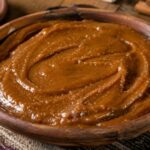
Peruvian Natillas
- Prep Time: 15 minutes
- Cook Time: 1 hour 30 minutes
- Total Time: 1 hour 45 minutes
- Yield: 12
- Category: Dessert
- Cuisine: Peruvian
Ingredients
- 2 liters fresh goat’s milk (8 cups)
- 500 g chancaca or dark panela, chopped
- 120 ml water (½ cup)
- 60 g rice flour (½ cup)
- 120 ml cold goat’s milk (½ cup), taken from the total amount
- 1 cinnamon stick
- 3 whole cloves
- 2 g baking soda (½ teaspoon)
Preparation
- Make the chancaca syrup, place the chopped chancaca and water in a small saucepan. Cook over medium heat for 8 to 10 minutes, stirring occasionally, until completely dissolved. Strain the syrup to remove any impurities and set it aside.
- Dissolve the rice flour, reserve 120 ml of the cold milk and whisk it with the rice flour and baking soda. Continue mixing until completely smooth and free of lumps, then set it aside for the thickening stage.
- Heat the milk, pour the remaining goat’s milk into a wide, heavy-bottomed pot. Add the cinnamon stick and cloves, then heat over medium heat while stirring with a wooden spoon. Bring it to a gentle boil without allowing the milk to rise over the edge of the pot.
- Add the chancaca, gradually pour in the strained syrup while stirring constantly. Once the mixture returns to a gentle simmer, lower the heat and cook for 20 minutes, stirring frequently so the milk does not stick or scorch.
- Thicken the natillas, remove the cinnamon and cloves. Stir the rice flour mixture again and slowly pour it into the pot while continuing to mix. Cook over low heat for 45 to 60 minutes, scraping the bottom and sides continuously, until the sweet turns caramel brown and becomes very thick.
- Check the consistency, draw the spoon across the bottom of the pot. The natillas are ready when the path remains visible for several seconds and the mixture begins to pull away from the sides. When lifted with the spoon, it should fall slowly and form thick folds.
- Shape and cool, immediately transfer the natillas to a shallow container, small serving dish, or individual molds. Smooth the surface with a slightly damp spoon and allow the dessert to cool completely at room temperature before covering it. It will become firmer as it rests.
Cooking Tips
- Use fresh goat’s milk for the traditional flavor. Cow’s milk makes a pleasant sweet but has a milder taste.
- Choose a wide, heavy-bottomed pot to encourage evaporation and reduce the risk of scorching.
- Do not increase the heat to shorten the cooking time. High heat can separate the milk, burn the chancaca, and create a bitter flavor.
- Stir more frequently as the mixture thickens, scraping the corners and the entire bottom of the pot.
- Always dissolve rice flour in cold milk to prevent lumps.
- Remove the natillas from the heat while they are still slightly softer than your desired final texture, as they firm considerably while cooling.
Traditional Variations
The oldest and most representative version uses goat’s milk, chancaca, and flour, preferably rice flour. This combination is documented as the traditional formula for Piura’s signature sweet.
Modern home recipes sometimes use cow’s milk when goat’s milk is unavailable. Some combine chancaca with granulated sugar or replace the rice flour with cornstarch, although the resulting texture is generally smoother and less similar to the traditional preparation.
Consistency also varies between households. Some cooks leave the natillas soft enough to eat with a spoon, while others continue cooking until the confection becomes compact enough to fill alfajores or cut into small portions.
Recommended Presentation
Serve the natillas at room temperature in small dessert bowls or on individual plates. They do not require sauces, fruit, or elaborate decorations because they are traditionally presented on their own, allowing the concentrated milk and chancaca flavor to stand out. You may also serve them directly from the shallow container in which they cooled. Because the dessert is rich and sweet, it pairs best with a hot beverage that contains little or no additional sugar.
Recommended Pairings
- Peruvian-style brewed coffee
- Unsweetened black tea
- Cinnamon tea
- Plain bread or simple cookies
- Natillas can also be enjoyed on their own as an after-meal sweet.
Did You Know?
Piura-style natillas should not be confused with the milk-and-egg custard known by the same name in Spain. The northern Peruvian dessert is a concentrated milk and chancaca confection whose prolonged cooking creates a texture similar to soft toffee. Traditional recipes use goat’s milk, although many modern commercial versions use cow’s milk and sugar. Besides being eaten directly with a spoon, natillas can be used as a filling for alfajores and other regional sweets. Their packaging in shallow containers and round tins has become a recognizable presentation for travelers visiting Piura.
Frequently Asked Questions
No. The traditional Piura recipe does not use eggs. It is made primarily from goat’s milk, chancaca, and rice flour. Its consistency comes from slowly reducing the milk and thickening it with flour, rather than from setting egg yolks as in Spanish-style custard.
Yes, but the flavor will be different. Goat’s milk provides the slightly pronounced character associated with the traditional dessert. When using cow’s milk, choose whole milk and avoid reduced-fat varieties, which contain less fat and produce natillas with less flavor and body.
A small amount of baking soda helps prevent the milk from curdling when combined with chancaca and encourages the development of a deeper caramel color. Do not exceed the stated amount because too much baking soda can leave an alkaline aftertaste and negatively affect the texture.
Use a heavy-bottomed pot, keep the heat low, and stir continuously once the mixture starts to thicken. Scrape the entire bottom and corners, where the sweet is most likely to stick first. Do not mix scorched pieces back into the dessert because they will give the whole batch a bitter flavor.
Store the natillas in an airtight container in the refrigerator for up to 5 days. Let them stand at room temperature for a few minutes before serving so they soften slightly. Always use a clean, dry spoon to prevent premature spoilage.