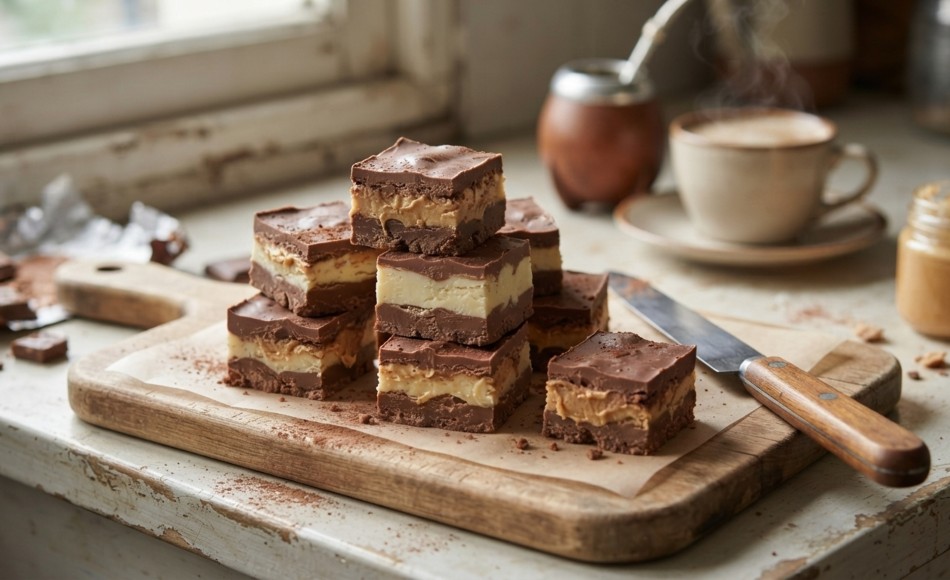
Marroc is one of Argentina’s best-loved homemade candies: a layered bite of milk chocolate, white chocolate, and peanut butter that balances sweetness, a creamy bite, and a distinct salty edge. Its story dates back to the 1920s, when Moroccan immigrants brought the recipe to the country, and the candy maker Felfort later turned it into a mass-produced classic found in nearly every corner store.
While store-bought bars are easy to find today, making marroc at home remains a common tradition for afternoon mate breaks, birthdays, and family gatherings, especially when it’s poured into a large pan and cut into small squares to share.
Print
Argentine Homemade Marroc
- Prep Time: 20 minutes
- Cook Time: 10 minutes
- Total Time: 2 hours 10 minutes
- Yield: 16 servings
- Category: Candy / Dessert
- Cuisine: Argentine
Ingredients
- 400 g of milk chocolate, chopped (14 oz / about 2 large bars)
- 200 g of white chocolate, chopped (7 oz / 1 large bar)
- 300 g of creamy peanut butter (1 1/4 cups)
- 1 pinch of fine salt (optional)
Preparation
- Line the pan, line a small rectangular pan (about 8 inches / 20 cm) with parchment paper or plastic wrap, leaving enough overhang on the sides to lift the candy out easily once set.
- Build the first layer, melt 7 oz of milk chocolate in the microwave in short bursts or over a double boiler, stir in 3.5 oz of peanut butter until smooth, and pour it into the pan in an even layer. Refrigerate for 15 to 20 minutes until firm.
- Add the middle layer, melt the white chocolate and mix it with another 3.5 oz of peanut butter until fully combined. Pour it over the set first layer and refrigerate again for 15 to 20 minutes.
- Finish with the top layer, melt the remaining 7 oz of milk chocolate, stir in the last of the peanut butter, and pour it over the white chocolate layer. Refrigerate for at least 1 hour, or until the marroc is completely firm.
- Unmold and slice, lift the candy out using the parchment overhang, set it on a cutting board, and slice it into even squares or rectangles with a sharp knife. Store in the refrigerator.
Practical Tips
- Use good-quality baking or couverture chocolate for a cleaner, more even slice.
- If your peanut butter is very thick, warm it slightly so it blends smoothly into the melted chocolate.
- Let each layer set completely before pouring the next one, so the colors stay distinct instead of blending together.
- Warm your knife slightly and wipe it clean between cuts for neat, even squares.
Traditional variations
- Some home versions add a thin layer of dulce de leche between the chocolate and the peanut butter.
- In some households, the milk chocolate is swapped for semisweet chocolate for a more intense flavor.
How to Enjoy It
Marroc is served cut into small squares, straight from the fridge, since the cold keeps the chocolate and peanut butter layers firm.
It’s usually eaten on its own as an afternoon treat, alongside mate or coffee.
Recommended sides
- Mate
- Coffee
A Bit of History
Marroc traces back to the Moroccan community that settled in Argentina in the early twentieth century and brought this chocolate-and-peanut combination with them. Felipe Fort, founder of the candy company Felfort, learned the recipe from these immigrants and began producing it industrially in 1927, making it one of the longest-running candies still sold in Argentina today.
Marroc now sits on store shelves alongside other Argentine classics like Rhodesia, Cofler, and Bon o Bon, and it remains a favorite treat to make at home for family gatherings.
Frequently Asked Questions
Marroc is an Argentine candy made of layered milk chocolate, white chocolate, and peanut butter. Its name refers to Morocco, since Moroccan immigrants brought the recipe to Argentina in the 1920s, and the candy company Felfort began producing it commercially soon after, turning it into one of the country's most iconic sweets.
Peanut butter is essential to marroc's soft texture and signature flavor, so it's not recommended to leave it out. If you prefer a milder taste, use a natural, unsweetened peanut butter instead, but avoid skipping it entirely, since it directly affects how the candy sets and how easily it slices.
Homemade marroc keeps well for up to two weeks when stored in an airtight container in the refrigerator, since warmth softens both the chocolate and the peanut butter. It can also be frozen, wrapped tightly in plastic, for up to a month — just thaw it in the fridge before serving.
Good-quality baking or couverture chocolate melts more evenly and gives cleaner, sharper slices once the candy sets. Chocolate with a higher cocoa butter content is easier to work with in layers and helps keep the marroc firm enough to hold its shape at room temperature.