
Facturas de grasa are a traditional style of Argentine pastry made with dough laminated using beef lard instead of butter, giving them a rustic, less-sweet flavor and a texture that’s crisp on the outside and tender within. They emerged as a more affordable alternative to butter-based facturas, made with a fat that was far more accessible to working-class families.
They’re sold in neighborhood bakeries across the country and are especially common in small inland towns and along rural highways, where they’re an essential part of breakfast and the afternoon merienda. They’re traditionally enjoyed with mate cocido, bitter mate, or coffee, and buying ‘a dozen’ at the local bakery remains an everyday ritual deeply rooted in Argentine popular culture.
Print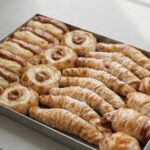
Argentine Lard Pastries
- Prep Time: 35 minutes
- Cook Time: 20 minutes
- Total Time: 2 hours 25 minutes
- Yield: 16 pieces
- Category: Pastry
- Cuisine: Argentine
Ingredients
- 500 g of all-purpose flour (Argentine 0000 or similar) (4 cups)
- 300 ml of warm water (1 1/4 cups)
- 20 g (or 7 g if using instant dry yeast) of fresh yeast (1 small cube)
- 15 g of sugar (1 tablespoon)
- 10 g of salt (2 teaspoons)
- 50 g of rendered beef lard or beef fat, melted (3 tablespoons)
- 200 g of beef lard, softened to room temperature (1 cup)
- Granulated sugar, for sprinkling, to taste (optional)
Preparation
- Activate the yeast, dissolve the fresh yeast and sugar in the warm water and let it sit for about 5 minutes until foam forms on the surface, a sign that the yeast is active and ready to use.
- Knead the base dough, in a large bowl combine the flour and salt, add the yeast water and the 50 g of melted lard, and knead on a floured surface for 8 to 10 minutes until you get a smooth, elastic dough that no longer sticks to your hands. Shape it into a ball, cover it, and let it rise in a warm spot for 60 minutes or until doubled in size.
- Laminate with the lard, roll the dough out on a floured surface into a rectangle about half a centimeter thick. Spread the softened lard evenly over the whole surface, fold the dough into thirds like a letter, and repeat the rolling and folding two more times to build the characteristic layers of facturas.
- Shape the pastries, roll the laminated dough out to about 3 millimeters thick and cut strips roughly 3 centimeters wide and 12 centimeters long. Roll each strip on itself with a slight twist to form the classic ‘vigilante’ shape, or simply coil it into a spiral for the plainer version.
- Let rest and bake, arrange the shaped pastries on a lightly greased baking sheet, spaced apart, and let them rise for 25 to 30 minutes until puffy. Bake in a hot oven at 220°C (425°F) for 15 to 18 minutes, until golden and crisp on the outside.
- Sprinkle and serve, take the pastries out of the oven and, while still warm, sprinkle granulated sugar over them to taste; this helps it stick and adds the characteristic sweet finish. Let cool for a few minutes before serving.
Baking Tips
- The lard should be cold or firmly at room temperature when you laminate; if it softens too much, chill it in the fridge for a few minutes before continuing.
- Work quickly during lamination so the lard doesn’t melt from the warmth of your hands, keeping the dough’s layers well defined.
- If you can’t find rendered beef lard, plain beef fat that’s been melted and cooled also works, though the flavor will be slightly less rich.
- A well-preheated oven is key: the pastries need a hot oven to rise quickly and turn crisp on the outside without drying out inside.
Traditional variations
- Vigilante: the same dough rolled with a portion of dulce de leche or cheese in the center.
- Cañoncito: the dough is rolled into a cone shape and filled with dulce de leche after baking.
- Sacramento: two strips of dough braided together with dulce de leche in the middle.
- Bola de fraile: a ball of dough that’s fried instead of baked, filled with dulce de leche or quince paste.
How to Enjoy This Recipe
Facturas de grasa are traditionally enjoyed fresh out of the oven or just warm, alongside mate cocido, bitter mate, or a hot café con leche. Buying them ‘by the dozen’ from the neighborhood bakery is a common ritual for sharing at breakfast or the afternoon merienda.
Recommended sides
- Mate cocido
- Café con leche
- Bitter mate (mate amargo)
A Bit of History
Facturas arrived in Argentina with Spanish and Italian immigrants in the late 19th century, and local bakers eventually developed the lard-based version as a cheaper, more accessible alternative to butter, which was far more expensive at the time.
Buenos Aires baking tradition holds that, in the early 20th century, workers with anarchist leanings gave provocative names to different facturas de grasa as a way of poking fun at figures of authority: ‘vigilante’ (policeman) mocked the police, while ‘sacramento’ and ‘bola de fraile’ (friar’s ball) poked fun at the Church. That naming tradition still lives on in Argentine bakeries today.
Frequently Asked Questions
Facturas de Grasa (Argentine Lard Pastries) is a traditional recipe made with simple ingredients and a homemade cooking method that preserves its authentic flavor.
The total time may vary depending on the recipe and number of servings, but it can usually be prepared by following the steps shown in the recipe.
It can be served with traditional side dishes, typical drinks, or simple accompaniments according to local customs.
Yes, in many cases it can be stored in the refrigerator in a sealed container and enjoyed the next day, as long as it is still fresh before serving.
Yes, you can make small adjustments based on your taste, but it is best to keep the main ingredients to preserve the traditional flavor.