
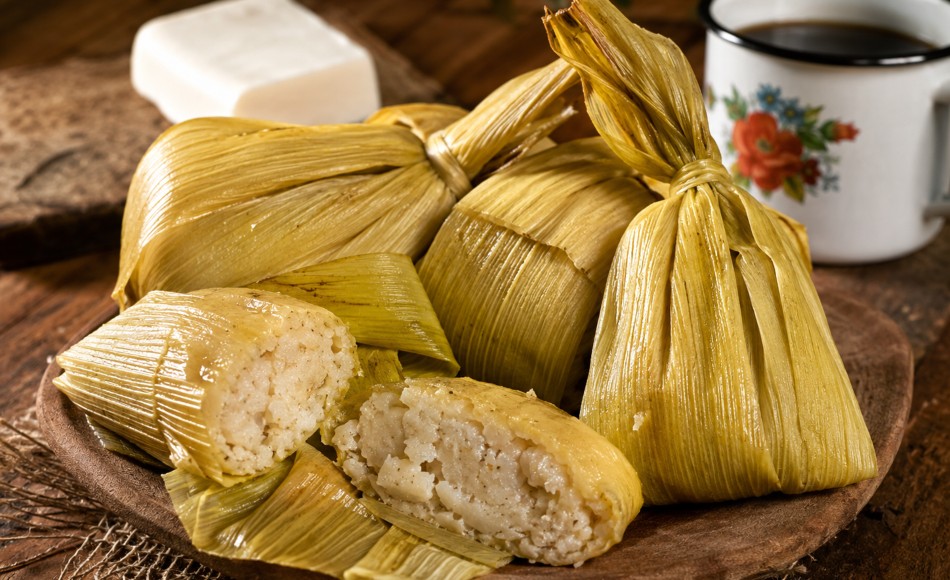
Coconut bollo is a traditional food from Colombia’s Caribbean coast, where corn and fresh coconut are everyday ingredients in home cooking. You make it with corn dough, grated coconut, coconut milk, salt, and, depending on the family recipe, a small amount of sugar.
Its gentle coconut aroma and moist texture make it a popular choice for breakfast, snacks, and coastal meals. The dough cooks inside corn husks, an ancestral technique that traps steam and gives each bollo its distinctive look.
Print
Colombian Coconut Bollo
- Prep Time: 30 minutes
- Cook Time: 55 minutes
- Total Time: 1 hour 25 minutes
- Yield: 12
- Category: Main Course
- Cuisine: Colombian
Ingredients
- 500 g fresh white corn dough (about 3 cups)
- 200 g freshly grated coconut (2 cups)
- 240 ml coconut milk (1 cup)
- 100 ml water (⅓ cup plus 1 tablespoon)
- 8 g salt (1 ¼ teaspoons)
- 50 g granulated sugar (¼ cup)
- 12 large clean corn husks
- 1.5 liters water (6 cups), for steaming
Preparation
- Wash the corn husks and let them drain. If they feel stiff, soak them in hot water for 3 minutes so they fold without tearing.
- Make the dough, place the fresh corn dough in a large bowl and add the grated coconut, coconut milk, water, salt, and sugar. Mix well with clean hands until you have a smooth, moist, even dough that holds together when you scoop it.
- Wrap the bollos, place about 75 g of dough, or roughly 3 heaping tablespoons, in the center of each husk. Fold the sides toward the middle, close both ends, and tie each bollo with thin strips of corn husk or kitchen string.
- Steam the bollos, line the bottom of a large pot with extra husks and arrange the wrapped bollos on top. Add the water without fully covering them, cover the pot, and cook over medium heat for 50 to 60 minutes. Check occasionally to make sure water remains in the bottom of the pot.
- Remove one bollo and carefully open the husk to check that the dough is firm and fully cooked in the center. Let the bollos rest for 10 minutes before serving them warm or at room temperature.
Chef’s tips
- Use freshly grated coconut for the most authentic flavor and a moist texture.
- Add the water gradually; the dough should be moist but never runny.
- Keep the bollos above the water, resting on the husks, so they cook with steam rather than boil directly.
- Reduce the sugar when you want a more savory bollo to serve with a main meal.
Traditional variations
Some families make coconut bollos without sugar and serve them with savory meals. Others add more sugar and enjoy them as a sweet snack, especially with coffee or Colombian costeño cheese.
How to serve
Serve coconut bollos warm, still wrapped in their corn husks. You can enjoy them for breakfast, as an afternoon snack, or alongside traditional Caribbean Colombian foods. Their flavor is especially good with salty costeño cheese and hot drinks.
Recommended accompaniments
- Fresh Colombian costeño cheese
- Costeño sour cream
- Colombian black coffee
- Hot chocolate
- Fried fish or coastal stews, when you make a low-sugar version
A culinary curiosity
Bollos are an important part of Colombian Caribbean cuisine and reflect long-standing corn-cooking traditions that use natural leaves as wrappers. Adding coconut reflects the abundance of this ingredient along the coast and the combined Indigenous and Afro-Caribbean influences that shape the region’s food culture.
Frequently Asked Questions
Yes, you can use pre-cooked cornmeal when fresh corn dough is unavailable. First hydrate it with warm water following the package directions, then mix in the coconut, coconut milk, salt, and sugar. Fresh dough gives you a more traditional texture, but pre-cooked cornmeal still produces a satisfying homemade bollo.
Both versions are traditional. Some families add sugar and serve it for breakfast or as a snack, while others use little or no sugar so it can accompany savory foods. Adjust the sugar based on how you plan to serve the bollos.
Open one after about 50 minutes of steaming. The dough should look firm, moist, and compact, with no raw or sticky center. It should also pull away from the corn husk easily without falling apart.
Keep them in an airtight container in the refrigerator for up to 3 days. To reheat them, steam them for a few minutes or place them in a covered pot with a small amount of water. This helps them regain moisture without becoming dry.