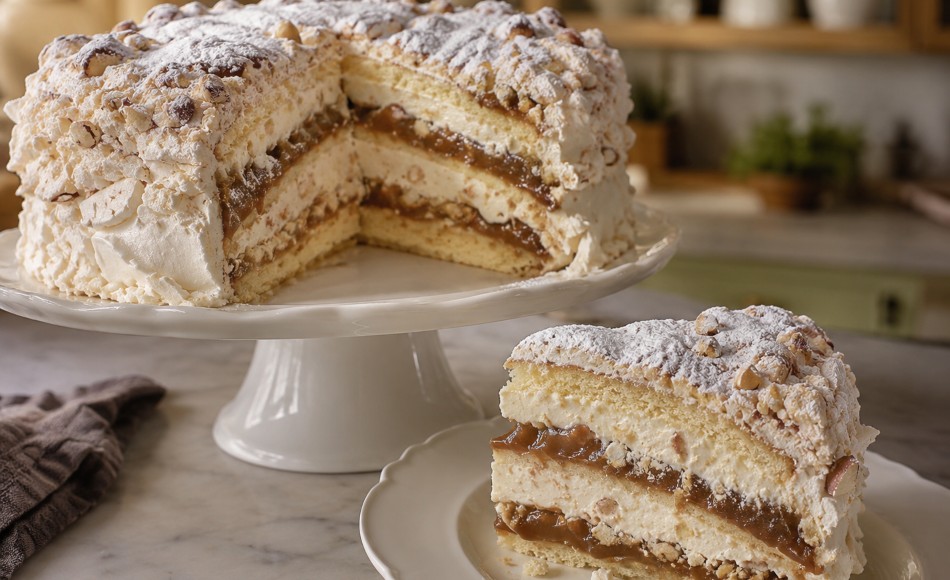
Postre Balcarce was born in 1950 at the “Paris” confitería of pastry chef Guillermo Talou, and became famous starting in 1958 when it arrived in Mar del Plata, where it turned into a symbol of the city and of Argentine pastry-making.
It’s a layered sponge cake with dulce de leche, small meringues, walnuts, and whipped cream, finished with coconut and powdered sugar; at the confitería, the top is branded with a hot iron.
Print
Argentine Postre Balcarce Cake
- Prep Time: 40 minutes
- Cook Time: 25 minutes
- Total Time: 3 hours 30 minutes
- Yield: 12 servings
- Category: Dessert
- Cuisine: Argentine
Ingredients
- 6 eggs
- 180 g of sugar (about 6.3 oz)
- 180 g of flour (about 1 1/2 cups)
- 1 teaspoon of vanilla extract
- 400 ml of heavy cream, well chilled
- 120 g of powdered sugar, plus extra for dusting
- Vanilla extract, to taste (for the cream)
- 400 g of reposteria-style (baker’s) dulce de leche (about 14 oz)
- 150 g of small dry meringues, broken into pieces
- 80 g of chopped walnuts
- 100 g of shredded coconut, for decorating
Preparation
- Make the sponge cake, beat the eggs with the sugar until tripled in volume, fold in the sifted flour and the vanilla extract.
- Bake, pour the batter into a mold and bake at 180°C (350°F) for 20 to 25 minutes. Let cool and cut into two or three discs.
- Make the whipped cream, whip the well-chilled cream with the powdered sugar and vanilla to stiff, whipped-cream consistency.
- Build the layers, place the first disc and cover it with dulce de leche and broken meringues; on the next disc spread walnuts and whipped cream. Repeat, alternating, and finish with a disc.
- Finish, cover the top with the remaining cream, sprinkle with shredded coconut, and dust with powdered sugar.
- Refrigerate and serve, refrigerate for at least 2 hours before slicing into portions and serving.
Tips for getting it right
- Let the sponge cake cool completely before slicing it into discs, so it doesn’t fall apart.
- The cream must be well chilled so it whips properly.
- Spread the walnuts and coconut evenly so every slice gets some crunch.
- Add the meringues only when assembling, so they stay crunchy.
Traditional variations
- The original recipe from the Paris confitería includes candied chestnuts in addition to walnuts.
- Some homemade versions use a pionono (thin sponge sheet) instead of the sponge cake, cut into rectangles or rolled.
How to serve
Postre Balcarce is served well chilled, cut into portions, as a dessert.
It’s a symbol of Mar del Plata’s pastry tradition and a classic at birthdays and family celebrations.
Recommended sides
- Coffee
- Tea
Did you know?
The dessert was born in 1950 at the “Paris” confitería, created by pastry chef Guillermo Talou, originally named “Imperial.”
In 1958 it moved to Mar del Plata, where it took the name “Balcarce” in reference to its creator’s hometown, and became a symbol of Argentina’s Atlantic coast.
Frequently Asked Questions
The name refers to the town of Balcarce, hometown of pastry chef Guillermo Talou, who created the dessert in 1950 and later popularized it in Mar del Plata.
It combines sponge cake, dulce de leche, small meringues, walnuts (candied chestnuts in the original), and whipped cream, topped with coconut and powdered sugar.
The broken meringues between the layers add the signature crunchy contrast to the cream and dulce de leche.
A minimum of 2 hours in the fridge is recommended, so the layers set and it's easier to slice.