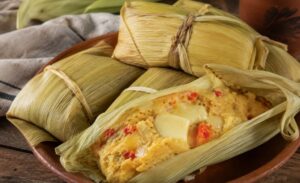
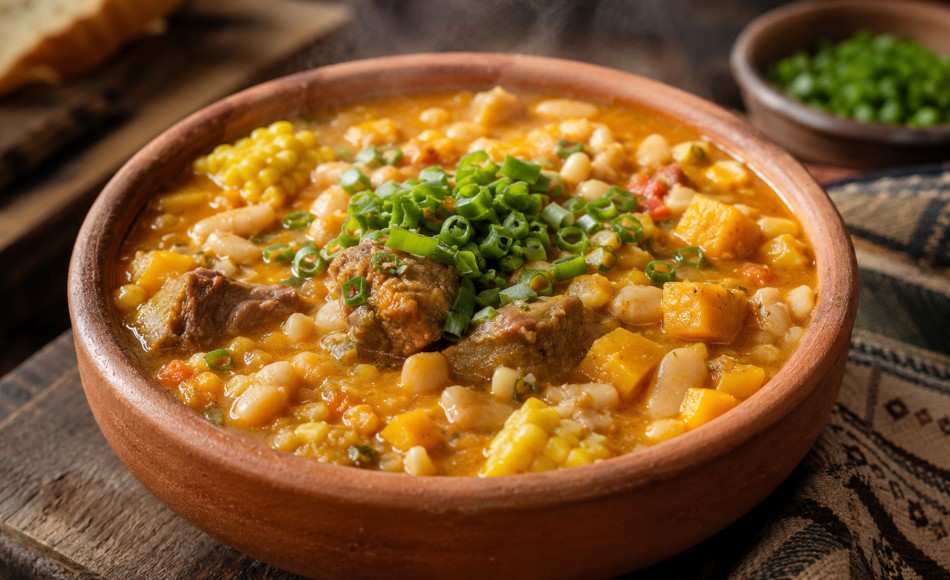
Locro is prepared differently depending on the region of Argentina, and in the northeastern provinces, like Misiones and Formosa, it’s common to replace cracked corn with cassava, a central ingredient of the region’s Guaraní cuisine.
The result is a stew just as hearty as traditional criollo locro, but with the distinctive texture and flavor that cassava brings instead of corn.
Print
Argentine Cassava Stew
- Prep Time: 30 minutes
- Cook Time: 1 hour 30 minutes
- Total Time: 2 hours
- Yield: 6 servings
- Category: Main Course
- Cuisine: Argentine
Ingredients
- 1 kg of cassava, peeled and cut into pieces (about 2.2 lb)
- 500 g of pumpkin or squash, cubed (about 1.1 lb)
- 500 g of beef (flank or roast beef cut), in pieces (about 1.1 lb)
- 2 pig’s feet (optional)
- 2 chorizos
- 3 tablespoons of oil
- 1 onion, cubed
- 1 bell pepper, cubed
- 2 scallions, chopped
- 2 carrots, cubed
- 750 ml of vegetable broth (about 3 cups)
- Salt, paprika, and cumin, to taste
Preparation
- Cook the vegetables, in a large pot with oil, cook the onion, bell pepper, scallion, and carrot until tender.
- Add the meats, stir in the beef pieces, pig’s feet, and chorizos, and cook a few minutes until the meat changes color.
- Season, add salt, paprika, and cumin, mixing well.
- Add the cassava, stir in the peeled, cut cassava.
- Cover with broth, pour in the vegetable broth to cover the ingredients.
- Simmer, cook over low heat for about 1.5 hours.
- Add the squash, stir in the cubed squash halfway through cooking, so it doesn’t fully fall apart.
- Finish, cook until all the ingredients are tender and the stew has a thick consistency, and serve piping hot.
Tips for getting it right
- Cut the cassava into even pieces so it cooks uniformly along with the rest of the ingredients.
- Remove the central fiber from the cassava before cooking, since it tends to stay tough even after cooking.
- Adding the squash halfway through cooking helps it add body to the stew without falling apart completely.
- This locro thickens naturally thanks to the cassava, without needing to add corn.
Traditional variations
- Some families combine cassava with a smaller portion of corn, for a result somewhere between both versions.
- It’s also made with more chorizo colorado for a more intense color in the stew.
How to serve
Locro norteño con mandioca is served piping hot, in individual bowls, as a main dish.
It’s a comforting dish typical of northeastern Argentina, perfect for cold days.
Recommended sides
- Crusty bread
- Red wine
- Spicy sauce
Did you know?
Locro has Quechua origins, known as “luqru” or “rucru,” but in northeastern Argentina, with its strong Guaraní influence, cassava naturally replaces corn in many traditional recipes.
This version reflects how the same dish adapts based on ingredients available in each region of the country, always keeping its essence as a thick, comforting stew.
Frequently Asked Questions
Because cassava is a central ingredient of the region's Guaraní cuisine, much more available than the traditional cracked corn of Andean-style locro.
Unlike the corn and beans in traditional criollo locro, cassava doesn't need pre-soaking; it just needs to be peeled and cut into pieces.
Yes, some families combine both ingredients in smaller amounts each, achieving a result somewhere between criollo locro and this northeastern version.
The cassava partially breaks down during the long cooking time, naturally providing the stew's characteristic thickness.