
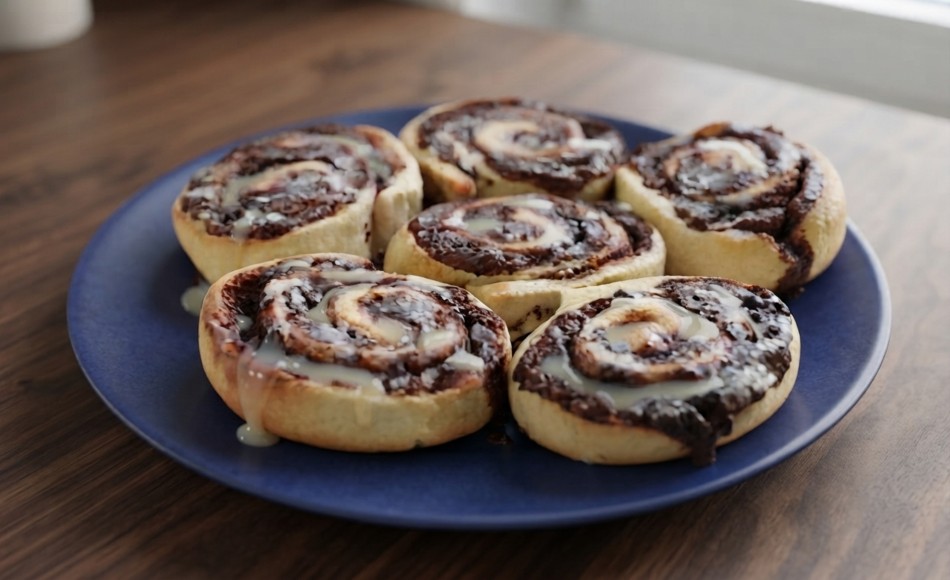
Argentine chocolate roll cake is a home-baking classic: a soft cocoa sponge rolled up while still warm and filled with dulce de leche, the ingredient that defines so much of the country’s dessert table.
It’s a common sight in neighborhood bakeries and pastry shops, and it turns up on family tables for birthdays, afternoon tea, and get-togethers, sliced into rounds and shared alongside coffee or mate.
Print
Argentine Chocolate Roll Cake
- Prep Time: 25 minutes
- Cook Time: 12 minutes
- Total Time: 57 minutes
- Yield: 8 servings
- Category: Dessert
- Cuisine: Argentine
Ingredients
- 4 large eggs, at room temperature
- 120 g of granulated sugar (1/2 cup plus 2 tablespoons)
- 90 g of all-purpose flour (3/4 cup)
- 30 g of unsweetened cocoa powder (3 tablespoons)
- 5 g of baking powder (1 teaspoon)
- 1 pinch of salt
- 400 g of dulce de leche, thick “repostero” style (1 1/2 cups)
- 30 g of powdered sugar, for dusting (3 tablespoons) (optional)
- Sugar for dusting the towel
Preparation
- Whip the eggs with the sugar, beat the eggs and sugar on high speed for about 8 minutes, until the mixture triples in volume and turns pale and foamy.
- Fold in the dry ingredients, sift the flour together with the cocoa powder, baking powder, and salt, then fold them into the egg mixture with gentle sweeping motions to keep the batter airy.
- Bake the sponge, pour the batter into a rectangular baking sheet lined with parchment paper, spread it evenly, and bake at 350°F (180°C) for 10 to 12 minutes, until the surface springs back when touched.
- Roll the warm sponge, turn the sponge out onto a clean kitchen towel dusted with sugar, peel off the parchment paper, and roll it up together with the towel from one short end; let it cool in this rolled shape.
- Fill with dulce de leche, carefully unroll the cooled sponge, spread the dulce de leche evenly over the surface, and roll it back up without the towel, tightening the shape as you go.
- Decorate and serve, dust the roll with powdered sugar, slice it, and serve.
Baking Tips
- Whip the eggs and sugar long enough: if the mixture doesn’t triple in volume, the sponge will crack when you roll it.
- Roll the sponge right out of the oven, while it’s still warm and flexible; if it cools first, it will crack.
- Use thick “repostero” style dulce de leche instead of the runnier table version, since it holds the roll’s shape better once sliced.
- Don’t overbake the sponge: even a couple of extra minutes will dry it out and make rolling difficult.
Traditional variations
- Some families fill the roll with whipped cream instead of dulce de leche, or combine both fillings.
- Some bakeries coat the outside with a chocolate glaze instead of dusting it with powdered sugar.
- There’s a version made with chopped walnuts mixed into the dulce de leche filling.
Serving Suggestions
Chocolate roll cake is served sliced into rounds about 3/4 inch (2 cm) thick, as a dessert or afternoon treat.
It’s commonly enjoyed with coffee or mate, especially at family gatherings and birthdays.
Recommended sides
- Coffee
- Mate
- A scoop of vanilla ice cream (as a dessert)
Origins and Tradition
Argentina’s chocolate roll cake is part of a home-baking tradition inherited from Italian and Spanish immigrant pastry-making, which brought over the rolled sponge cake techniques common in central European baking.
Over time, that sponge became paired with dulce de leche, a defining ingredient of Argentine food culture, giving rise to a homegrown version that’s now a fixture in bakeries, pastry shops, and family tables across the country.
Frequently Asked Questions
Argentine Chocolate Roll Cake with Dulce de Leche is a traditional recipe made with simple ingredients and a homemade cooking method that preserves its authentic flavor.
The total time may vary depending on the recipe and number of servings, but it can usually be prepared by following the steps shown in the recipe.
It can be served with traditional side dishes, typical drinks, or simple accompaniments according to local customs.
Yes, in many cases it can be stored in the refrigerator in a sealed container and enjoyed the next day, as long as it is still fresh before serving.
Yes, you can make small adjustments based on your taste, but it is best to keep the main ingredients to preserve the traditional flavor.