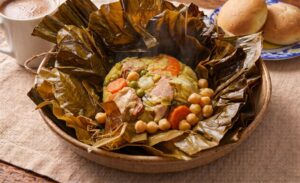
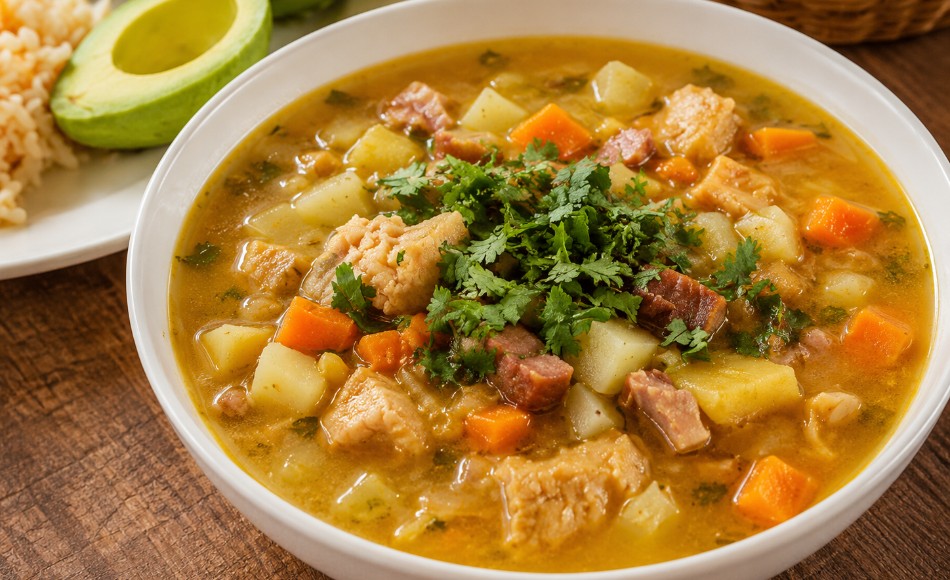
Mute santandereano is one of the most emblematic dishes of Santander and Norte de Santander. It is a hearty, thick soup that combines several meats (including tripe and beef trotter), hulled corn, chickpeas, vegetables, and pasta.
It is made with about 20 ingredients and served thick. Its origin is linked to adafina, a stew of Spanish and Portuguese Jews; “mute” means corn in Quechua.
Print
Colombian Santander Mute
- Prep Time: 30 minutes
- Cook Time: 1 hour 55 minutes
- Total Time: 2 hours 25 minutes
- Yield: 6
- Category: Soup
- Cuisine: Colombian
Ingredients
- 375 g beef ribs
- 250 g pork
- 375 g beef tripe (callo/mondongo)
- 350 g beef trotter (pata de res), skinned and chopped
- 125 g chickpeas, soaked
- 125 g fresh green beans (fríjol verde)
- 300 g cooked yellow hulled corn (maíz pelado)
- 200 g cooked white hulled corn (maíz pelado)
- 250 g auyama (Colombian squash)
- 1 small eggplant
- 250 g papa pastusa (Colombian white potatoes), sliced
- 60 g pasta (shells)
- 2 sprigs guacas
- 3 sprigs parsley
- ½ stalk long green onion
- Salt to taste
For the hogao
- 200 ml annatto-infused oil (aceite achiotado)
- 2 stalks long green onion
- 110 g ripe tomato
- cumin, pepper, and salt to taste
Preparation
- Cook the tripe and trotter. In a pressure cooker, cook the washed and chopped tripe for 30 minutes from when the pot starts to whistle; discard that broth. In the same pot, add the skinned, chopped trotter with water and cook 35 minutes more. Set aside the trotter with its broth.
- Cook the meats and legumes. Meanwhile, in a large pot place the ribs, pork, long green onion, and enough water to cover. Bring to a boil and cook 10 minutes; add the chickpeas, green beans, and both corns, cover, and cook 35 minutes.
- Make the hogao. While you wait, heat the annatto oil and sauté the long green onion and tomato with cumin, pepper, and salt until you have a thick guiso. Mix the hogao with the reserved tripe and trotter.
- Combine everything. When the trotter is ready, pour its broth into the large pot, add the auyama and eggplant, and cook until the auyama breaks down.
- Add the potatoes. Add the sliced potato and cook 10 minutes.
- Add the pasta and hogao. Add the pasta and salt to taste and cook 10 minutes; stir in the hogao with the tripe and trotter and cook 5 more minutes. Serve with the chopped guacas and parsley.
Note: The chickpeas are used already soaked; that time is not included in the total time shown. The hulled corn is used already cooked. If you do not have a pressure cooker, the tripe needs 1½ to 2 hours of simmering.
Chef’s Tips
Use the chickpeas already soaked.
Wash the tripe well before cooking.
Cooking mute on a wood-fired stove and getting the corn and meat very tender is part of what makes the dish.
Traditional Variations
Some versions add canario or red beans, carrot, arracacha, and macaroni.
If you do not want tripe, you can leave it out and use the rest of the ingredients.
Traditional Serving Style
Serve mute santandereano piping hot, accompanied by white rice and avocado.
Recommended Side Dishes
- White rice
- Avocado
- Arepa
Frequently Asked Questions
Mute stands out for combining several meats (including tripe and beef trotter), hulled corn, chickpeas, and vegetables, resulting in a much thicker, heartier soup than most sancochos.
Yes. Hulled corn is the ingredient that gives the dish its name ("mute" means corn in Quechua).
Yes. The recipe uses one to cook the tripe and trotter; without it, the tripe needs 1½ to 2 hours of simmering.
Yes. Refrigerate it within 2 hours of cooking and eat it within 3 to 4 days; you can also freeze it in airtight containers. Always reheat to 74 °C (165 °F).
Because it combines corn, legumes, auyama, and potato, which release starches during cooking.