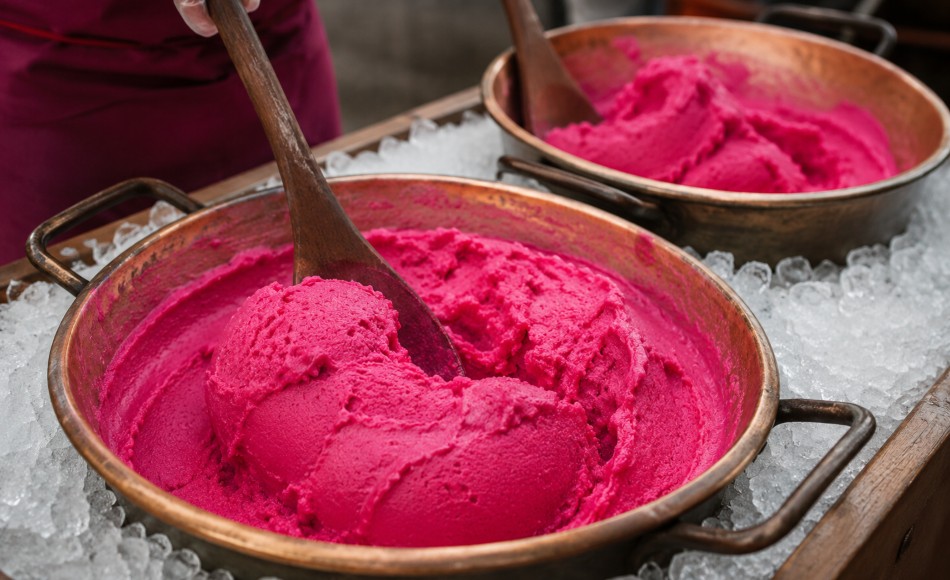
Helado de paila is one of Nariño’s most representative desserts. It is traditionally made in a copper or bronze pan placed over crushed ice and salt, while the fruit mixture is hand-stirred until it gradually freezes into its characteristic creamy texture.
In Pasto and other towns across Nariño, this dessert is part of fairs, outings, and local food traditions. In earlier times, makers used ice collected from the Cumbal snowcapped mountain and treated with sea salt; today, the method continues with commercial ice and coarse salt.
Print
Colombian Helado de Paila
- Prep Time: 20 minutes
- Cook Time: 25 minutes
- Total Time: 1 hour 15 minutes
- Yield: 8
- Category: Dessert
- Cuisine: Colombian
Ingredients
For the blackberry mixture
- 500 g fresh ripe blackberries (about 4 cups)
- 500 ml whole milk (2 cups)
- 180 g granulated sugar (¾ cup plus 2 tablespoons)
- 5 ml vanilla extract (1 teaspoon)
- 1 g ground cinnamon (½ teaspoon)
- 15 ml fresh lemon juice (1 tablespoon)
For the ice bed
- 3 kg crushed ice
- 900 g coarse salt or sea salt
- 500 ml cold water (2 cups), only if needed to pack the ice bed
Preparation
- Make the blackberry base, wash the blackberries and blend them with the milk, sugar, vanilla, cinnamon, and lemon juice until smooth. Strain through a fine sieve to remove the seeds, then refrigerate the mixture for 30 minutes.
- Build the ice bed, place a layer of crushed ice in a large tub, cooler, or deep container. Sprinkle with part of the salt, add more ice, and repeat until you have a firm base. Add a small amount of cold water only if you need to compact the ice.
- Chill the paila, place a food-safe copper paila over the ice-and-salt bed. Move it gently for about 2 minutes to cool the metal well before adding the blackberry mixture.
- Churn the ice cream, pour about 250 ml of the cold mixture into the paila. Continuously scrape and stir with a wooden spoon while rotating the paila over the ice. Once the mixture starts freezing along the sides, scrape it away and keep stirring.
- Finish and serve, add the remaining mixture in small batches and continue stirring for 20 to 25 minutes, until you have a thick and creamy frozen dessert. Serve immediately in cones or chilled dessert cups.
Chef’s Tips
- Keep the blackberry mixture very cold before adding it to the paila to shorten the churning time.
- Use crushed ice instead of large cubes so it surrounds the paila more evenly.
- Prevent salty water from entering the fruit mixture.
- Keep scraping the paila walls so the ice cream does not freeze into hard sheets.
Traditional Variations
In Nariño, helado de paila is also made with strawberry, lulo, soursop, passion fruit, coconut, mango, and lemon. Natural fruit, sugar, and hand-churning over ice and salt remain the foundation of this traditional technique.
How to Serve
Serve helado de paila immediately in cones, small cups, or dessert bowls. It is traditionally enjoyed on its own so the fruit flavor and light texture remain the focus.
You can serve it with a simple wafer or sweet cookie.
Recommended Accompaniments
- Plain wafers
- Sweet cookies
- Wafer rolls
- Colombian coffee, served separately
Did You Know?
Helado de paila gets its texture from the contact between the fruit mixture and the cold walls of the pan. The frozen layer is scraped, stirred, and worked repeatedly until it turns into a smooth frozen cream; this handmade process can take about 25 minutes.
Frequently Asked Questions
Yes. For a home version, use a wide stainless-steel pan or bowl, although copper or bronze is the traditional material. The important thing is to use a sturdy, food-safe container with enough direct contact with the ice-and-salt bed.
Salt helps lower the temperature of the ice mixture, allowing the paila to become cold enough to freeze the fruit base gradually. The salt should never touch the ice cream mixture because it would affect the flavor.
Not necessarily. Traditional Nariño-style helado de paila highlights natural fruit and can be made with milk or with a more fruit-forward base. Its texture comes mainly from constant hand-churning and the artisanal freezing process over ice and salt.