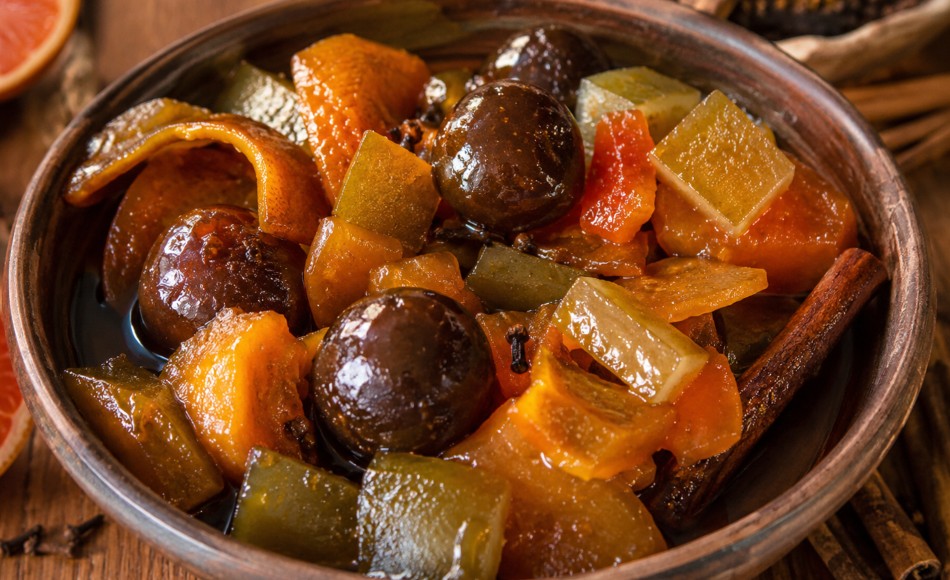
Desamargado is a traditional sweet from Colombia’s Valle del Cauca region, especially associated with Christmas. Its name refers to the patient process of repeatedly boiling citrus peels to remove their bitterness before simmering them in a panela syrup flavored with spices.
The classic Valle del Cauca version combines bitter orange, grapefruit, and lemon peels with green papaya and figs. It is a dessert built on slow cooking and family food traditions: each ingredient keeps its shape while absorbing the dark, fragrant syrup.
Ingredients
- 2 large bitter oranges, about 500 g
- 2 large grapefruits, about 700 g
- 4 large lemons, about 400 g
- 500 g peeled green papaya
- 500 g fresh figs
- 700 g grated panela (3½ cups)
- 1.5 liters water (6 cups)
- 2 g baking soda (½ teaspoon)
- 1 cinnamon stick, about 8 cm long
- 2 g whole cloves (4 cloves)
Preparation
- Prepare the citrus peels, wash the bitter oranges, grapefruits, and lemons thoroughly. Cut them in half, remove all of the pulp, and keep only the peels. Cut the orange and grapefruit peels into strips or half-moons, then cut the lemon peels into smaller strips.
- Boil away the bitterness, place the peels in a wide pot, cover them with water, and boil for 15 minutes. Drain and discard the water, then repeat this process 3 times. Add the baking soda during the final boiling to help preserve the peels’ color, then rinse them with cold water.
- Prepare the fruit, cut the green papaya into cubes about 2 cm wide. Make a shallow cross-shaped cut at the base of each fig so it absorbs the syrup more easily. Cook the papaya and figs separately in water for 10 minutes, then drain and set aside.
- Make the panela syrup, place the panela, 1.5 liters of water, cinnamon, and cloves in a large pot. Cook over medium heat until the panela dissolves completely and the syrup comes to a gentle boil.
- Cook the desamargado, add the debittered peels, papaya, and figs to the syrup. Lower the heat and simmer for 45 to 60 minutes, stirring gently from time to time, until the fruit is tender, glossy, and fully infused with syrup.
- Rest and serve, remove the cinnamon and cloves. Let the dessert cool in the pot, then refrigerate it for at least 6 hours, preferably overnight, so the flavors fully develop.
Chef’s tips
- Repeat the boiling process as needed; some grapefruits require one extra boil to reduce their bitterness.
- Do not remove every bit of the white pith, since it adds texture and helps the peels hold their shape.
- Use good-quality panela for a deeper cane flavor and richer color.
- Let the dessert rest before serving; it tastes more balanced the next day.
- Handle the figs and papaya gently so they do not break apart.
Traditional variations
Some Valle del Cauca households add papayuela, citron, or sweet-orange peels depending on seasonal availability. Other families make desamargado using only grapefruit, a simpler variation that still relies on repeated boiling followed by slow cooking in spiced syrup.
How to serve
Serve desamargado chilled or at room temperature in small dessert bowls, with a generous spoonful of syrup. In Valle del Cauca, it is traditionally enjoyed in December alongside other holiday sweets and often paired with fresh cheese or cuajada.
Recommended pairings
- Queso campesino or fresh farmer cheese
- Fresh cuajada
- Black Colombian coffee
- Hot chocolate
- Colombian natilla
A little history
Valle del Cauca desamargado is part of the region’s Christmas food tradition. The practice of repeatedly boiling and draining citrus peels transforms intensely bitter fruit into a fragrant sweet, reflecting cooking knowledge passed through generations.
Its combination of citrus peels, green papaya, figs, panela, cinnamon, and cloves is one of the most recognizable expressions of this regional dessert.
Frequently Asked Questions
Grapefruit, lemon, and bitter-orange peels contain naturally bitter compounds. Boiling them repeatedly and discarding the water reduces that strong bitterness before the peels are cooked with panela. The exact number of boils can vary by fruit, but the goal is to make the peels pleasant without losing their citrus character.
Yes. Grapefruit desamargado is a traditional, simpler version of this Colombian dessert. Follow the same basic method: remove the pulp, boil the peels several times to reduce bitterness, and then simmer them in panela or sugar syrup with cinnamon and cloves.
Keep it in a clean, covered container in the refrigerator for 7 to 10 days. The fruit should remain covered with syrup for the best preservation. Its flavor often improves after one or two days, when the peels have had more time to absorb the spiced syrup.
Yes, but it changes the result. White sugar makes a lighter, more neutral syrup, while panela adds a deeper color, cane aroma, and flavor closer to the traditional Valle del Cauca version. Use panela when you want to preserve the dessert’s regional character.