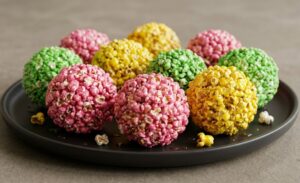
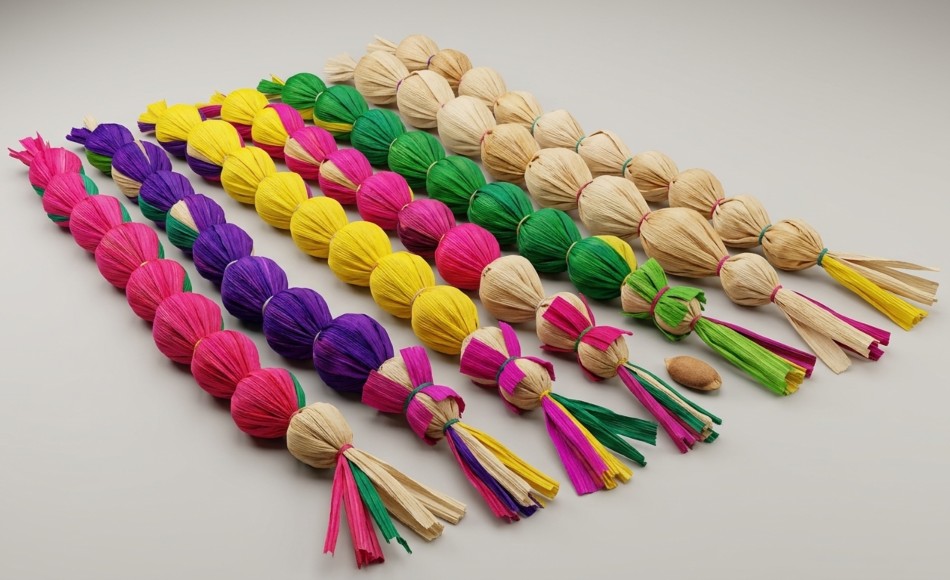
Rosarios de dulce are a traditional Guatemalan sweet of small sugar or panela beads strung on thread, forming the shape of a rosary, typical of Esquipulas.
It’s an artisanal sweet associated with the pilgrimage to the Black Christ of Esquipulas, traditionally sold as an edible religious keepsake.
Print
Esquipulas Sugar Bead Rosaries
- Prep Time: 30 minutes
- Cook Time: 15 minutes
- Total Time: 45 minutes
- Yield: 10 pieces
- Category: Dessert
- Cuisine: Guatemalan
Ingredients
- 2 cups of sugar
- 1/2 cup of water
- 1 teaspoon of lemon juice
- Food coloring, to taste (optional)
- 1 thick cotton thread, food-safe
Preparation
- Make the syrup, place the sugar, water, and lemon juice in a pot, and cook over medium heat until it reaches the soft-ball stage.
- Color, if desired, add a few drops of food coloring and mix well.
- Cool slightly, let the mixture cool for a few minutes, enough to handle it.
- Shape the beads, with lightly greased hands, shape small beads the size of a rosary bead.
- String, while the beads are still warm and somewhat pliable, string them onto the cotton thread, forming the shape of a rosary.
- Dry, let dry and fully harden before handling or storing.
Tips for getting it right
- Working quickly is essential, since the beads harden within minutes of forming.
- Using thick, food-safe cotton thread is important for the sweet’s safety.
- The soft-ball stage is checked by dropping a bit of syrup in cold water: it should form a ball that flattens easily.
- It’s an artisanal sweet that takes some practice to achieve an even strand.
Traditional variations
- It’s a sweet traditionally sold in Esquipulas, associated with the pilgrimage to the Black Christ.
- Some rosaries are made in different colors, alternating beads of different shades.
How to serve
Rosarios de dulce are kept as an edible keepsake, eaten little by little, bead by bead.
They’re a traditional artisanal sweet of Esquipulas, with strong religious and cultural meaning.
Recommended sides
- None, eaten on its own
Did you know?
Rosarios de dulce are an artisanal product traditionally sold to pilgrims visiting the shrine of the Black Christ of Esquipulas.
They combine religious tradition with popular confectionery, being both a sweet and a symbolic object.
Frequently Asked Questions
They're an artisanal Guatemalan sweet of sugar beads strung on thread forming the shape of a rosary, typical of Esquipulas.
They're traditionally sold to pilgrims visiting the shrine of the Black Christ of Esquipulas, as an edible religious keepsake.
Thick, food-safe cotton thread is used, onto which the sugar beads are strung.
It takes some practice, since the beads harden quickly and must be strung while still pliable.