
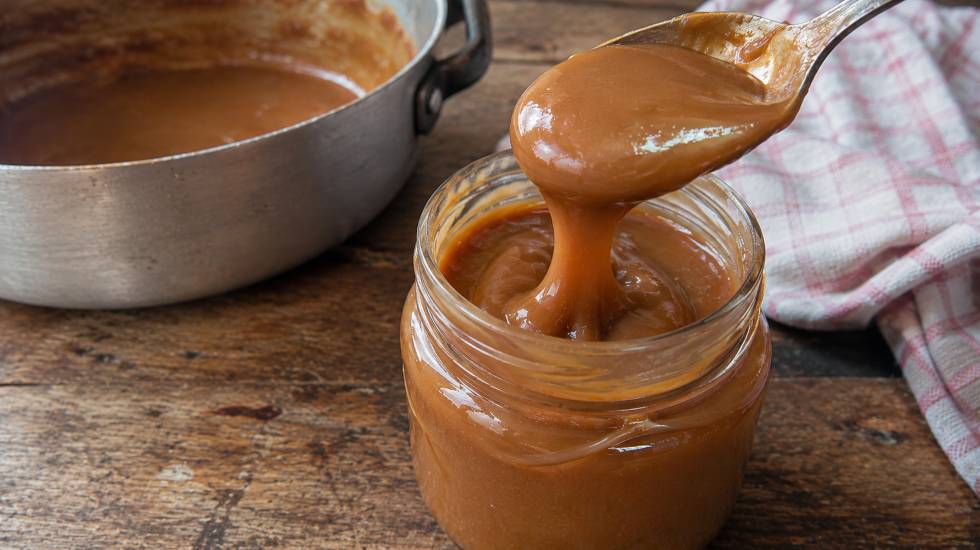
Dulce de leche is one of Argentina’s most iconic sweet preparations. It is made by slowly cooking milk with sugar until it turns into a thick, glossy caramel-colored cream.
Its tradition is strongly connected to the Río de la Plata region and everyday Argentine cooking. It is used as a spread, a filling for alfajores, cakes, crêpes, pastries, and many classic desserts.
In Argentina, dulce de leche is enjoyed at breakfast, during afternoon merienda, and in family celebrations. It is more than a sweet spread; it is a true symbol of Argentine food culture.
Print
Homemade Dulce de Leche
- Prep Time: 5 minutes
- Cook Time: 2 hours
- Total Time: 2 hours 5 minutes
- Yield: 8
- Category: Dessert
- Cuisine: Argentinian
Ingredients
- 1 liter whole milk (4 cups)
- 300 g white sugar (1 ½ cups)
- 1 g baking soda (¼ teaspoon)
- 5 ml vanilla extract (1 teaspoon)
Preparation
- Place the milk and sugar in a large heavy-bottomed pot. Stir well and heat over medium heat until the sugar completely dissolves. Add the baking soda carefully and continue stirring until the initial foam subsides.
- Lower the heat and cook the mixture slowly for about 1 hour and 30 minutes, stirring occasionally to prevent sticking. The mixture will gradually turn golden and thicken.
- Continue cooking for another 20 to 30 minutes, stirring more frequently as it thickens. When it reaches a deep caramel-brown color and a creamy texture that coats the spoon, remove from heat.
- Add the vanilla extract, stir well, and let the dulce de leche cool for a few minutes. Transfer it to a clean jar and let it cool completely before refrigerating.
Chef’s tips
- Use whole milk for the creamiest and most traditional texture.
- Stir more frequently toward the end, because the mixture thickens quickly and can stick.
- Do not increase the heat to speed things up; the classic flavor comes from slow cooking.
- Baking soda helps create the traditional color and keeps the milk stable.
- For a smoother finish, gently whisk the dulce de leche for a few seconds after cooking.
Traditional variations
- In Argentina, dulce de leche repostero is a thicker version used for cakes, pastries, and alfajores.
- Classic dulce de leche is creamier and easier to spread.
- In some homes, a little extra vanilla is added for a stronger aroma.
How to serve
Serve Argentine dulce de leche spread on bread, toast, medialunas, or cookies. It is also traditionally used to fill alfajores, crêpes, cakes, and rolled sponge cakes.
It pairs beautifully with mate, coffee with milk, or tea during afternoon merienda.
Recommended pairings
- Homemade bread
- Medialunas
- Butter cookies
- Crêpes
- Alfajores
- Mate
- Coffee with milk
Did you know?
Dulce de leche is so important in Argentina that it has its own celebration: World Dulce de Leche Day is observed every October 11.
Frequently Asked Questions
Baking soda helps develop the classic caramel color and improves the texture during cooking. It also helps keep the milk from curdling. Use only a small amount, because too much can affect the flavor and leave a slightly bitter taste.
It is ready when it has a caramel-brown color, a creamy texture, and coats the spoon without running off too quickly. You can also place a small amount on a cold plate; if it thickens and looks glossy as it cools, it has reached the right point.
Traditional Argentine dulce de leche is made with whole milk because it gives better richness, flavor, and creaminess. Low-fat milk can thicken, but the result is usually less smooth and less full-bodied. For an authentic result, whole milk is best.
Stored in a clean, tightly closed jar, homemade dulce de leche lasts about 1 to 2 weeks in the refrigerator. Always use clean utensils when serving it and keep it chilled after opening to preserve its flavor and texture.
It can become grainy if the sugar did not dissolve properly at the beginning, if the heat was too high, or if it was not stirred enough. To prevent this, mix well at the start, cook slowly, and stir more often as the mixture thickens.