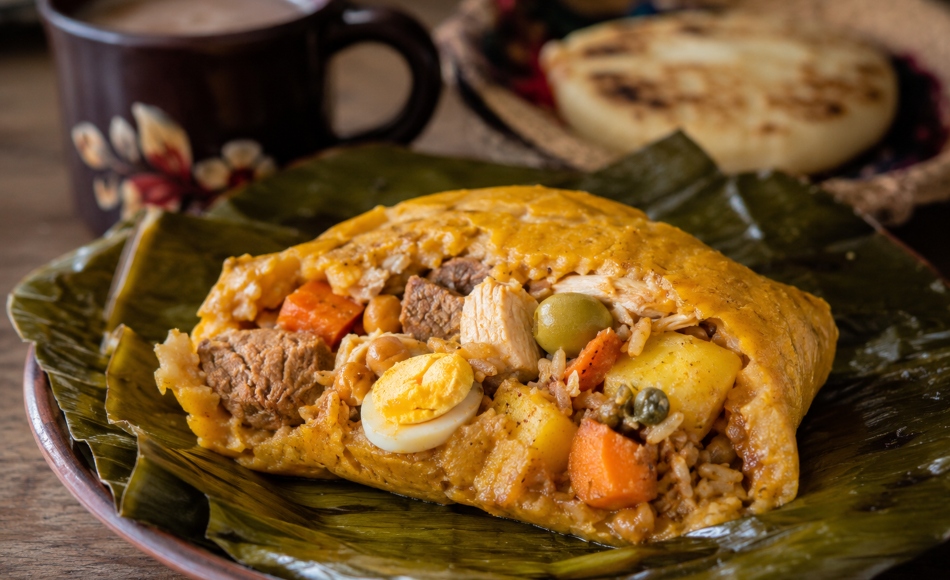
Colombian llanero-style hallaca, also called hayaca in some areas, is a traditional preparation from Colombia’s Eastern Plains. This version follows the Arauca recipe documented by Colombia’s Ministry of Culture: a corn flour dough seasoned with cumin and achiote, filled with rice cooked with peas, pork ribs and boneless pork, pork belly, potatoes, and a sofrito of scallions, chives, garlic, and bell pepper, all wrapped in bijao or topocho leaves and cooked in boiling water.
In the Llanos, hallacas are commonly prepared for family celebrations, end-of-year gatherings, regional festivities, and special meals. Making them is often a collective task: one person prepares the leaves, another makes the sofrito, another seasons the dough, and several people help assemble the packets.
Although it is related to other hallacas from the Colombian-Venezuelan region, the Colombian llanero version has its own character: generous, well seasoned, wrapped in aromatic leaves, and deeply connected to family traditions in the plains.
Print
Colombian Llanero Hallaca
- Prep Time: 1 hour 30 minutes
- Cook Time: 2 hours 45 minutes
- Total Time: 7 hours
- Yield: 10 to 12 servings
- Category: Main Course
- Cuisine: Colombian
Ingredients
For the rice with peas
- 1 kg rice (2 lb)
- 250 g green peas (½ lb)
- Enough water to cook the rice with the peas until the rice is done
For the sofrito and meats
- ½ cup oil
- 500 g scallions, finely chopped (1 lb)
- 500 g chives or green onion tops, finely chopped (1 lb)
- 5 heads garlic, crushed
- 1 bell pepper, chopped
- 1 kg pork ribs, chopped (2 lb)
- 2 kg boneless pork, chopped (4 lb)
- 500 g pork belly or bacon slab, chopped (1 lb)
- 1 kg potatoes, sliced (2 lb)
- Salt, to taste
For the dough
- 1 kg corn flour (2 lb)
- Water, added gradually until you get a thick dough that is not too runny
- 10 level tablespoons ground cumin
- 10 level tablespoons achiote or annatto coloring
- Salt, to taste
For wrapping and cooking
- 20 bijao or topocho (plantain) leaves, softened over heat
- Kitchen twine or topocho strips for tying
Preparation
- Soak the peas and cook the rice, soak the peas for 3 hours; then drain them and cook them together with the rice in water until the rice is done.
- Make the sofrito, heat the oil in a large pot and sauté the scallions, chives, garlic, and bell pepper.
- Mix the filling, when the sofrito is ready, add the ribs, pork, pork belly, potatoes, and the cooked rice with peas, season with salt, and mix well.
- Make the dough, dilute the corn flour in water and add salt, the cumin, and the achiote, stirring until you get a thick dough that is not too runny.
- Assemble the hallacas, lay two bijao leaves one on top of the other and spread a portion of dough over them. Place a portion of the rice, meat, and sofrito mixture on the dough, wrap everything in the same leaves, and tie with twine.
- Cook the hallacas, cook them for 2 hours in a large pot of boiling water. Remove them, let them rest, and serve.
Chef’s Tips
Soften the leaves well before assembling the hallacas, because this makes them flexible and helps release their aroma during cooking.
Soak the peas ahead of time: they need 3 hours before being cooked with the rice.
The dough should be thick and not too runny so it can be spread over the leaves without dripping.
Divide the filling without overloading each hallaca, so you can wrap and tie it properly.
Let the hallacas rest before serving so the dough sets and the filling keeps its shape better.
Traditional Variations
According to the traditional Arauca recipe, the pork can be replaced with chicken or beef.
If you like, you can add chili and wedges of hard-boiled egg to the dough.
Traditional Serving Style
Llanero-style hallaca is served hot, opened directly on the same leaf in which it was cooked. It can be enjoyed as a hearty breakfast, family lunch, or main dish during celebrations.
Traditionally, it is paired with Colombian coffee, hot chocolate, aguapanela, or cold regional drinks depending on the time of day. Because the filling is generous, it is often served on its own as a complete meal.
Recommended Pairings
- Colombian coffee
- Hot chocolate
- Hot aguapanela
- Llanero-style arepa
- Homemade ají
- Cold fruit drink, depending on family custom
Food Tradition
The word hallaca coexists with the spelling hayaca in different parts of Colombia, especially in popular and regional contexts. In the Llanos, this dish is linked to celebration meals and the custom of cooking together when several hallacas are made to share.
This recipe was part of the First Creole Food Recipe Contest held in Arauca in 1989 by the Cravo Norte Association, and it was collected in Paseo de olla, the Ministry of Culture’s compilation of Colombian regional cooking.
Frequently Asked Questions
Hallaca and hayaca are used to name very similar preparations, wrapped in leaves and slowly cooked. In Colombia, hayaca appears in several areas as a popular or regional spelling. The difference usually depends more on local and family usage than on a completely different recipe.
They are not exactly the same, although they share regional roots and similar techniques. This Arauca version is made with a corn flour dough seasoned with cumin and achiote, and a filling of rice cooked with peas, pork, pork belly, potatoes, and sofrito.
Yes. In this Arauca recipe, the rice is cooked together with the soaked peas and then mixed with the sofrito, pork, pork belly, and potatoes to make the filling.
The hallacas cook for 2 hours in a large pot of boiling water; then they rest before serving.
Yes, you can freeze them after they are cooked and completely cooled. Keep them well wrapped to preserve moisture. To reheat them, steam them or warm them in hot water without removing the leaf until heated through.