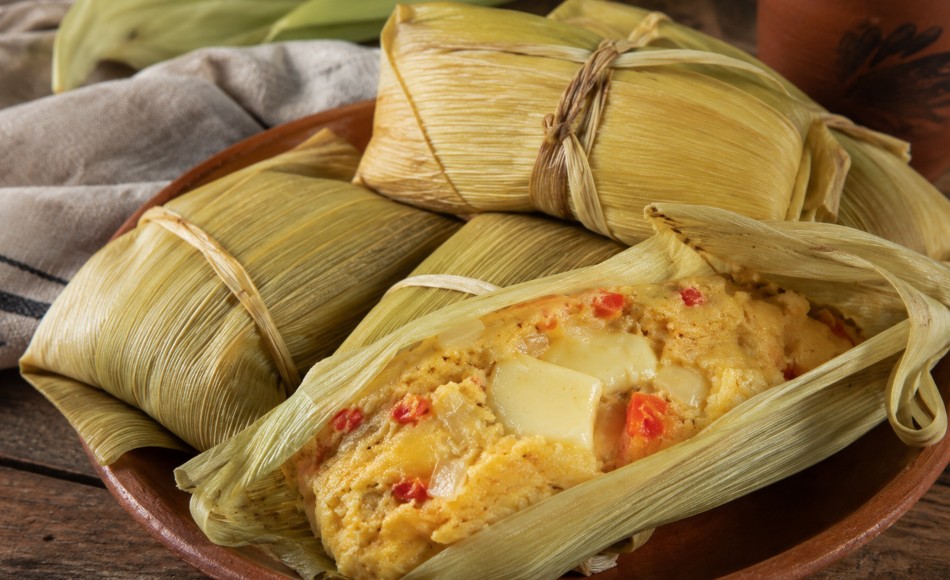
Humita en chala is an iconic dish from northwestern Argentina, especially Salta, Jujuy, Tucumán, and Catamarca, with roots going back to pre-Columbian indigenous cultures that wrapped corn dough in the ear’s own husks to steam it.
Unlike empanadas de humita, which use the corn filling inside a dough disc, here the corn mixture is wrapped and tied inside the chalas (corn husks), which give it its characteristic shape and aroma during steaming.
Print
Argentine Corn Husk Tamales
- Prep Time: 45 minutes
- Cook Time: 30 minutes
- Total Time: 1 hour 15 minutes
- Yield: 8 tamales
- Category: Main Course
- Cuisine: Argentine
Description
Traditional Andean recipe made with ground fresh corn and cheese, adapted into an easy-to-follow home version with exact proportions.
Ingredients
- 8 of ears of corn, with their husks whole
- 1 of onion, chopped
- 1 of bell pepper, chopped
- 3 tablespoons of butter
- 150 g of cheese, cubed (mozzarella or similar) (about 5.3 oz)
- 1 teaspoon of paprika
- a few leaves of fresh basil, chopped (optional)
- 1 teaspoon of sugar
- to taste of salt and crushed red pepper
- as needed of kitchen twine or thin corn husk strips, for tying
Instructions
- Husk the corn, carefully remove the husks trying to keep them as whole as possible; set the husks and cobs aside separately.
- Prepare the corn, grate the kernels with a coarse grater or cut them off, then process until you get a smooth paste.
- Cook the onion and pepper, in a skillet with butter, cook the chopped onion and bell pepper until soft.
- Mix the dough, combine the processed corn with the cooked onion and pepper, paprika, basil, sugar, salt, and crushed red pepper.
- Soften the husks, cover the husks with hot water and boil for a few minutes until soft and pliable. Let them cool.
- Assemble the tamales, cross two husks on a cutting board, spoon a couple ladles of the corn dough into the center, and add two cubes of cheese.
- Wrap and tie, fold the husks toward the center covering the filling well, and tie with kitchen twine or thin husk strips so they don’t open.
- Steam, place the cobs at the bottom of a large pot, cover with water, form a base of husks, and arrange the tamales on top without touching the water. Cover and steam over medium-low heat for about 30 minutes.
Tips for getting them right
- Husk the corn carefully to keep the husks whole and in good condition, since they wrap and shape each tamale.
- The base of cobs and husks at the bottom of the pot keeps the tamales from touching the water directly during steaming.
- Tying each tamale well is key so it doesn’t open and the filling doesn’t leak out during cooking.
- The touch of sugar balances the savory filling without turning it into a sweet dish.
Traditional variations
- Some families add a little milk to the corn dough for a creamier texture.
- They’re also made without cheese, as a simpler version, though the melted cheese cube in the center is very traditional.
How to serve
Humita en chala is served hot, straight out of the pot, untying and opening the husks on the plate.
It’s a classic dish for winter afternoons in northern Argentina, enjoyed with family.
Recommended sides
- Mate cocido tea
- Crusty bread
- Simple salad
Did you know?
The origin of humita en chala goes back to pre-Columbian indigenous cultures of northwestern Argentina, who were already wrapping and cooking corn dough in the ear’s own husks long before the Spanish arrived.
Unlike humita en olla (cooked as a stew) or empanadas de humita, this version keeps the traditional wrapped, tied shape, steamed inside its own husks.
Frequently Asked Questions
Empanadas de humita use the corn filling inside a baked or fried dough disc, while humita en chala wraps the corn mixture directly in the ear's husks and steams it.
That base keeps the tamales from coming into direct contact with the boiling water, allowing them to steam evenly.
Yes, although the melted cheese cube in the center is a very traditional feature, it can be left out for a simpler version of the corn filling.
Generally about 30 minutes over medium-low heat, with the pot covered, until the corn dough inside the husks is firm and cooked through.